LED Mask FDA Approval: What U.S. Shoppers Need to Know

At-home LED masks are generally not “FDA-approved.” Most are “FDA-cleared” through a process called 510(k), which confirms the device is substantially equivalent to products already on the market. That distinction matters more than most marketing pages let on.
Two authorities back this up. The American Academy of Dermatology confirms most at-home LED and red-light devices fall into this cleared category, not the approved one. The Soneda Lumira LED Face & Neck Mask is one such product, and we flag its status here for transparency rather than as a claim of superiority.
What clearance actually means for you:
- It confirms a baseline level of safety and manufacturing quality.
- It does not mean the device matches clinic-grade power or results.
- It does not mean the FDA tested the device for effectiveness the way a drug trial would.
Key Takeaways
FDA clearance confirms an LED mask meets baseline safety standards through the 510(k) process, not that it matches clinic-grade results.
| Point | Details |
|---|---|
| Clearance, not approval | Nearly all at-home LED masks are FDA cleared under 510(k), not FDA approved under PMA. |
| Verify the K-number | Search the FDA’s public device listings for the exact K-number before trusting any marketing claim. |
| Eye protection is non-negotiable | Wear goggles every session and follow the manufacturer’s duration and frequency instructions. |
| Set realistic timelines | Expect several weeks of consistent use before judging acne or texture improvements. |
| Choose transparent specs | The Soneda Lumira LED Face & Neck Mask publishes wavelength and safety details for readers who want a vetted at-home option. |
Table of Contents
- What FDA Clearance Actually Means for LED Masks
- How to Verify an LED Mask’s FDA Status Yourself
- Safety Rules and Who Should Skip At-Home LED Therapy
- Does the Science Support At-Home LED Masks?
- What to Check Before You Buy an LED Mask
- Our View on At-Home LED Therapy
- A Vetted Option: the Soneda Lumira LED Face & Neck Mask
- Frequently Asked Questions
- Sources
What FDA Clearance Actually Means for LED Masks
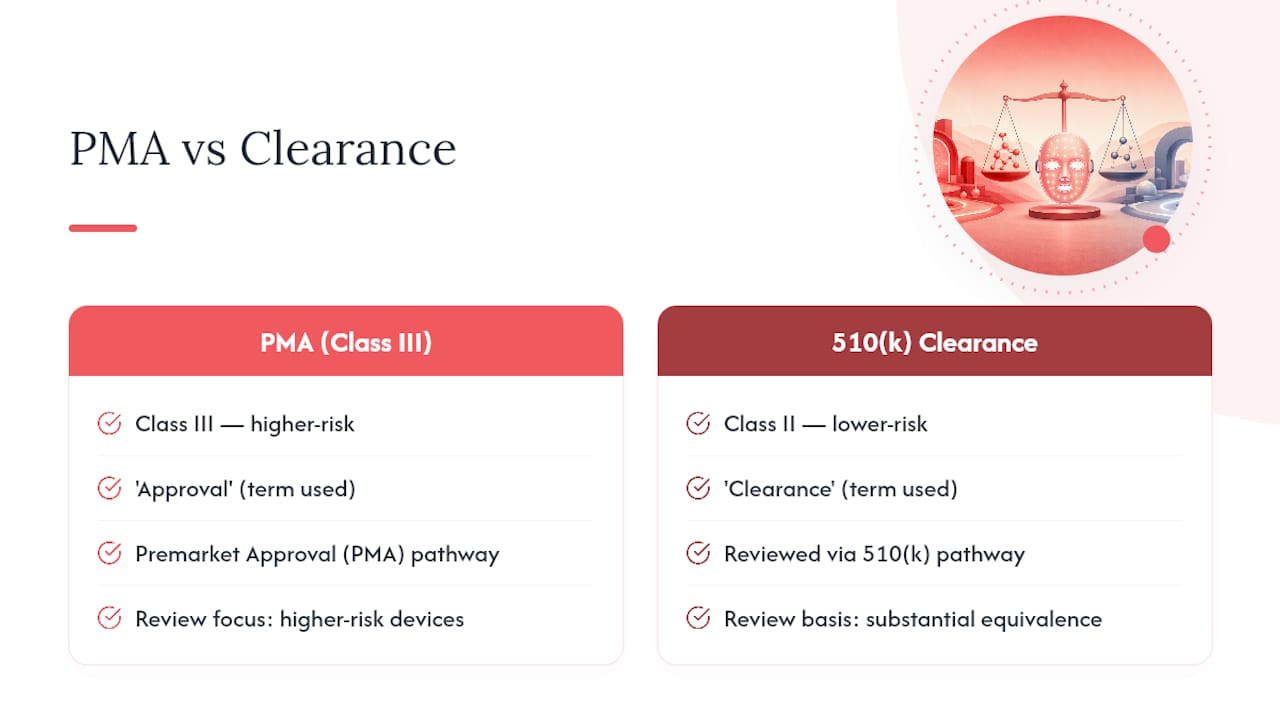
Here’s the legal distinction in one sentence: FDA “approval” applies to higher-risk Class III devices reviewed under a Premarket Approval (PMA) application, while FDA “clearance” applies to lower-risk Class II devices reviewed under the 510(k) pathway. Nearly every at-home LED mask on the market falls into that second category.
Clearance rests on a concept called substantial equivalence. A manufacturer shows the FDA that its new device works similarly to an existing, legally marketed device (called a predicate) in terms of intended use, design, and safety profile. That’s a much lower bar than proving a device outperforms anything else. It’s why a $200 LED mask and a $2,000 in-office panel can both carry a form of FDA clearance despite delivering very different results, since WebMD notes clearance signals low public risk, not clinical superiority.
A 510(k) clearance requires real work from the manufacturer: safety testing, defined manufacturing controls, and specific labeling about intended use. What it doesn’t require is proof that the device performs as well as a dermatologist’s equipment, or even that it works dramatically better than doing nothing. Those are two very different things, and confusing them is the single most common mistake shoppers make.
Pro Tip: Scan the box and the product page for the exact phrase “FDA cleared” alongside a K-number (it looks like K123456). If you only see “FDA approved” with no K-number anywhere, treat that as a red flag rather than reassurance.
How to Verify an LED Mask’s FDA Status Yourself
You don’t need to take a brand’s word for it. Four steps get you a definitive answer in about ten minutes.
- Check the packaging first. Look for “FDA cleared” or “510(k)” printed near the safety information, along with a K-number.
- Search FDA public records. Plug the K-number or device trade name into the FDA’s 510(k) database or CDRH device listings to see the official indications for use.
- Ask the manufacturer directly. A legitimate company will hand over its 510(k) number along with documented wavelengths and irradiance, measured in mW/cm².
- Confirm safety standards. Look for IEC or ISO markings on the spec sheet, plus a clear list of contraindications in the instructions.
Real 510(k) summaries are public documents. One example, a cleared wrinkle and acne LED device, lists its device class, indications for use, and the predicate device it was compared against. Another summary for a light therapy face mask documents its exact wavelength range and irradiance output. That’s the level of detail a real clearance produces. Vague marketing lines like “clinically inspired” or “dermatologist-grade” don’t show up in any FDA filing, because they aren’t regulatory language at all.
Safety Rules and Who Should Skip At-Home LED Therapy
Wear eye protection every session, and follow the manufacturer’s guidance on duration and frequency exactly. LED masks are low-risk when used correctly, but misuse causes real problems.
The most common issues include:
- Eye strain or damage from skipping protective goggles.
- Skin burns from a damaged device or cracked LED panel.
- Increased photosensitivity when LED use overlaps with certain medications.
Some people should not start at-home LED therapy without medical guidance first. That list includes anyone taking photosensitizing drugs, anyone with active severe skin disease, and anyone with compromised wound healing. Cleveland Clinic recommends talking to a board-certified dermatologist before beginning regular at-home LED sessions, particularly if you have a preexisting skin or health condition.
A device being FDA cleared confirms it’s reasonably safe for the general population. It doesn’t confirm it’s safe for your specific medications, skin condition, or medical history. Only a dermatologist can make that call.
Pro Tip: Start with two or three short sessions a week at the lowest recommended duration. Stop immediately and call a doctor if you notice unusual redness that doesn’t fade within a few hours, blistering, or vision changes.
Does the Science Support At-Home LED Masks?
Some at-home LED devices carry genuine clinical data behind specific claims, particularly for mild-to-moderate acne and early signs of aging. That evidence varies a lot depending on wavelength, irradiance, and how consistently someone follows the treatment protocol.
Clinic devices typically run at higher irradiance than anything sold for home use. WebMD reports that lower power at home generally means more modest, slower results, not a lack of results altogether.
Where the evidence is strongest:
- Reduction in mild acne lesions with consistent blue or red light use.
- Improvements in skin texture and fine wrinkle appearance with red and near-infrared wavelengths.
Where it’s thinner: claims around deep wrinkle reversal, pigmentation correction, and dramatic firming tend to outrun what at-home irradiance levels can realistically deliver. Most users evaluating an at-home LED routine should give it 8 to 12 weeks of consistent use before judging results, then reassess with realistic expectations. For more on this gap between marketing and measurable outcomes, see how at-home light therapy devices actually perform against clinic equipment.
What to Check Before You Buy an LED Mask
A quick checklist separates a legitimate device from a marketing gimmick:
- A clear “FDA cleared” claim with a visible K-number, not a vague “FDA approved” label.
- Published wavelengths and irradiance in mW/cm², not just marketing terms like “medical-grade light.”
- IEC or ISO electrical and optical safety markings on the spec sheet.
- Clear written instructions and contraindications, not a single-line disclaimer buried in fine print.
- U.S.-based warranty and customer support you can actually reach.
Red, near-infrared, and blue wavelengths carry the strongest clinical backing for skin texture, aging, and acne, respectively. Masks advertising six or seven “proprietary” colors often lean on unsupported claims for the extras. Compare specs across a few options in our breakdown of top LED light therapy devices before deciding.
Pro Tip: A brand that publishes exact irradiance and recommended session length is giving you enough information to estimate your actual light dose. A brand that won’t share those numbers usually doesn’t want you comparing.
Our View on At-Home LED Therapy
Buy safety-first, not marketing-first. Check the K-number before you check the reviews, and talk to a board-certified dermatologist if you have any preexisting skin condition or take photosensitizing medication.
Sonedaskincare builds devices around published specs, not vague promises, because shoppers deserve to know exactly what they’re using on their face.
A Vetted Option: the Soneda Lumira LED Face & Neck Mask
Sonedaskincare built the Soneda Lumira LED Face & Neck Mask around exactly the checklist above: published wavelengths, four-wavelength light therapy, and clear specs instead of vague “clinical” language.
We don’t claim it outperforms clinic-grade equipment. What we do promise is transparency: you get the wavelength details and safety instructions up front, with U.S.-based support if you have questions before or after you buy. If you’re comparing at-home LED options and want a device that matches the verification checklist in this article, view the Lumira mask’s full specifications and preorder details before your next skincare purchase.
Frequently Asked Questions
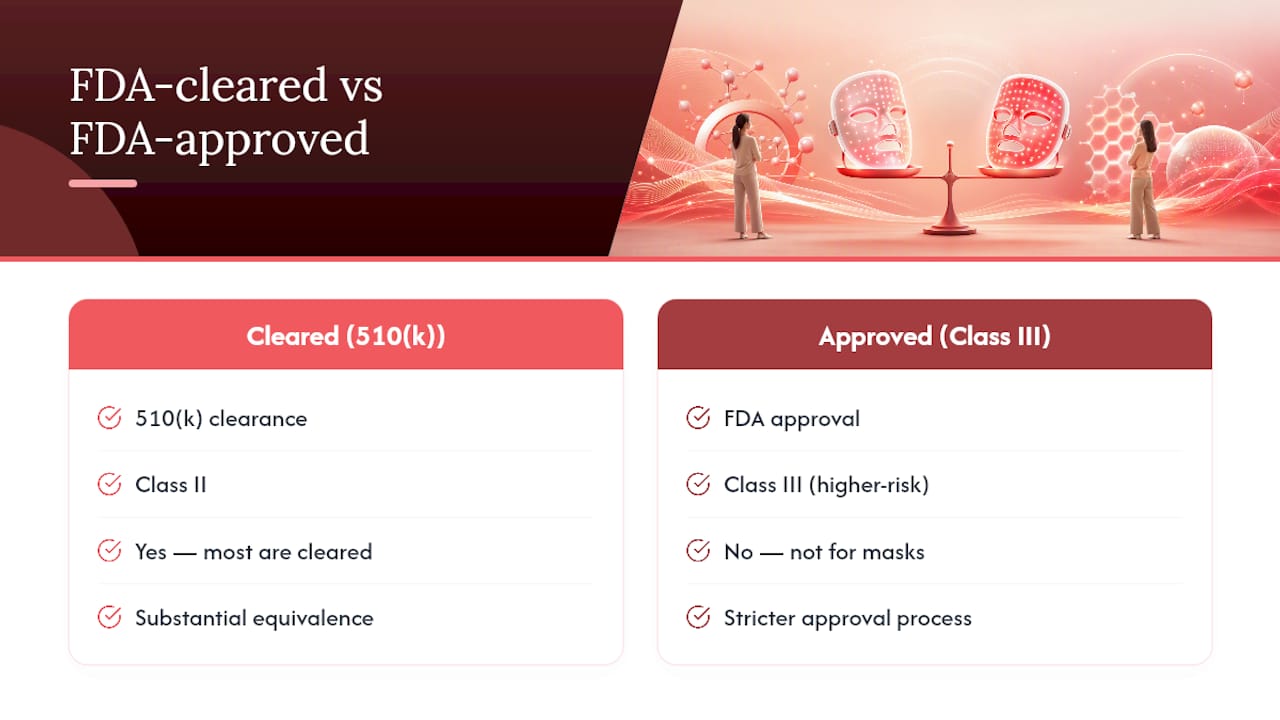
Is an LED mask FDA-approved or FDA-cleared? Almost every at-home LED mask is FDA-cleared through the 510(k) pathway, not FDA-approved. Approval applies to higher-risk Class III devices, a category at-home LED masks don’t fall into.
Does an LED mask need FDA approval to be sold legally? No. Class II LED masks only need 510(k) clearance, which confirms substantial equivalence to an existing legally marketed device rather than requiring the stricter approval process.
How do I know if my specific LED mask is FDA-cleared? Look for a K-number on the packaging or product page, then search that number in the FDA’s 510(k) database to confirm the device’s cleared indications for use.
Are FDA-cleared LED masks safe to use every day? Follow the manufacturer’s specific frequency guidance rather than assuming daily use is safe for every device. Overuse can cause skin irritation even with a cleared, low-risk device.
Should I see a dermatologist before starting LED therapy at home? Yes, particularly if you take photosensitizing medication or have an active skin condition. A board-certified dermatologist can flag risks a product label won’t mention.
Sources
- Is red light therapy right for your skin?
- LED Light Therapy: How It Works, Colors, Benefits & Risks
- LED Light Therapy: How It Works, Colors, Benefits & Risks