Does Near-Infrared Light Actually Improve Your Skin?

Yes, near-infrared light can measurably help your skin, provided you use it at the right intensity and stay consistent. At therapeutic, low irradiance levels, near-infrared (NIR) light stimulates cellular energy production, supports collagen synthesis, and activates wound-healing pathways in skin tissue. The clinical signal is real: research on mitochondrial photobiomodulation shows NIR is absorbed by cytochrome c oxidase inside mitochondria, boosting ATP output and setting off a chain of repair signals that show up clinically as smoother texture, fewer fine lines, and faster wound closure.
Before you buy a device or book a session, run through this checklist:
- Check the wavelength and irradiance. Look for NIR in the 760 to 1,400 nanometer range and an irradiance figure listed in mW/cm², not just marketing language like “clinical grade.”
- Start low and build up. Begin with shorter sessions at the lower end of the recommended range rather than maxing out intensity on day one.
- Talk to a dermatologist if you have darker skin, take photosensitizing medication, or have an active skin condition. These factors change your risk profile and your starting dose.
That’s the verdict in a nutshell. The rest of this guide breaks down why it works, what the evidence actually supports, and how to dose it correctly so you don’t waste money or risk your skin.
Key Takeaways
Near-infrared light therapy supports collagen production and wound healing through a mitochondrial mechanism, but only within a specific, moderate irradiance range, not at maximum intensity.
| Point | Details |
|---|---|
| NIR works through mitochondria | Absorption by cytochrome c oxidase raises ATP output, driving collagen synthesis and reduced inflammation. |
| Intensity beats total exposure | The therapeutic sweet spot sits around 30 to 35 mW/cm²; higher irradiance can inhibit rather than help. |
| Hyperpigmentation is the exception | Texture, fine lines, and wound healing respond well; hyperpigmented spots typically do not improve. |
| Results take months, not days | Expect subtle change in weeks and clearer improvement between 8 and 24 weeks of consistent use. |
| Check before you buy or book | Confirm wavelength, irradiance, and FDA clearance language before trusting any device’s claims. |
| Soneda offers a specs-first home option | Soneda’s multi-wavelength LED and HIFU devices align with the calibrated irradiance and consistency this guide recommends. |
Table of Contents
- What Is Near-Infrared Light and How Does It Work on Skin?
- What Does the Evidence Say About Near-Infrared Benefits for Skin?
- Near-Infrared vs. Red Light: Which One Do You Actually Need?
- Is Near-Infrared Light Safe for Your Skin?
- How Do You Use Near-Infrared Light Safely at Home or in a Clinic?
- Why Does Light Intensity Matter More Than Total Exposure Time?
- When Will You See Results From Near-Infrared Therapy?
- Should You Use an At-Home NIR Device or Get Professional Treatment?
- What I’ve Learned Weighing the Hype Against the Data
- A Home Device Built Around the Specs That Actually Matter
- Sources
What Is Near-Infrared Light and How Does It Work on Skin?
Near-infrared light sits just past the visible red spectrum, typically defined as the 760 to 1,400 nanometer range. Red light therapy, by contrast, uses shorter wavelengths, generally in the 620 to 700 nanometer band. That difference in wavelength determines how deep the light actually travels into your tissue.
Harvard Health’s overview of red light therapy explains that red light tends to act on the outer skin layers, while near-infrared light penetrates deeper, reaching the dermis and even subcutaneous tissue. Think of it like sunlight through a window shade: red light is the light that lands on the surface, while NIR is the light that keeps going, warming the layers underneath. That extra depth is exactly why NIR gets used for deeper repair work, like collagen remodeling and inflammation control, rather than just surface glow.
The mechanism behind this is cellular, not cosmetic. NIR photons get absorbed by an enzyme called cytochrome c oxidase, which sits inside your mitochondria, the energy factories of your cells. That absorption increases production of ATP, the molecule your cells burn as fuel, while also reducing reactive oxygen species that contribute to cellular stress. Mechanistic studies on mitochondrial photobiomodulation link this energy boost directly to downstream effects: more collagen synthesis, calmer inflammatory signaling, and better conditions for tissue repair.
None of this means every NIR device delivers the same result. The mechanism is well established in animal and laboratory models, and increasingly in human studies, but exact dosing windows differ depending on whether you’re targeting wrinkles, wound healing, or inflammation. That nuance matters more than most marketing pages let on, and it’s the reason irradiance, not just wavelength, ends up being the real variable to watch.
What Does the Evidence Say About Near-Infrared Benefits for Skin?
The clinical picture for near-infrared therapy is genuinely encouraging, but it’s not uniform across every skin concern. Some outcomes have solid, repeated support. Others are promising but thinner on data.
A trial following patients through several months of daily far-infrared treatment found notable improvement in skin texture, along with histological evidence of increased collagen and elastin in vitro, according to research on infrared radiation and photo-aged skin. That same body of research found one clear limit worth remembering: hyperpigmentation typically did not improve with infrared exposure, regardless of how long treatment continued. If uneven pigment is your primary concern, NIR is not your best tool.
Wound healing and tissue remodeling show some of the strongest support in the literature. A clinical evidence summary on photobiomodulation points to randomized trials where low-level, nonthermal infrared exposure sped healing times and improved collagen deposition, measured histologically rather than just by patient impression. That’s an important distinction: patient-reported smoothness is a real outcome, but biopsy-confirmed collagen changes carry more scientific weight.
| Skin outcome | Evidence strength | What was measured |
|---|---|---|
| Texture and fine lines | Moderate | Patient-reported improvement plus histologic collagen and elastin increases |
| Wound healing | Promising | Faster healing times, histologic collagen improvement in controlled trials |
| Inflammation reduction | Moderate | Reduced reactive oxygen species, calmer inflammatory markers in lab models |
| Hair regrowth | Promising | Increased follicle counts in animal models, dose-dependent response |
| Hyperpigmentation | Limited | No meaningful improvement reported in infrared-only trials |
A few things complicate clean conclusions here. Many trials combine red and near-infrared wavelengths rather than isolating NIR alone, which makes it hard to credit one wavelength over the other for a given result. Session frequency and irradiance also vary widely between studies, from daily far-infrared exposure to biweekly combined-light protocols. That variation is normal in early-stage photobiomodulation research, but it means you should read “improved skin texture” claims with an eye toward how the study actually dosed the light.
- Texture and fine-line improvements tend to build gradually over multiple weeks, not overnight.
- Wound-healing benefits show up in controlled, nonthermal, low-level exposure, not high-heat treatments.
- Objective measures like biopsy and histology carry more weight than self-reported satisfaction surveys.
- Hyperpigmentation is the one outcome where NIR alone consistently underdelivers.
Near-Infrared vs. Red Light: Which One Do You Actually Need?
The short answer: it depends on how deep your target sits. Red light works on superficial concerns because it doesn’t travel far past the epidermis and upper dermis. Near-infrared reaches further, which makes it the better match for deeper dermal remodeling, inflammation control, and repair work that red light alone can’t touch.
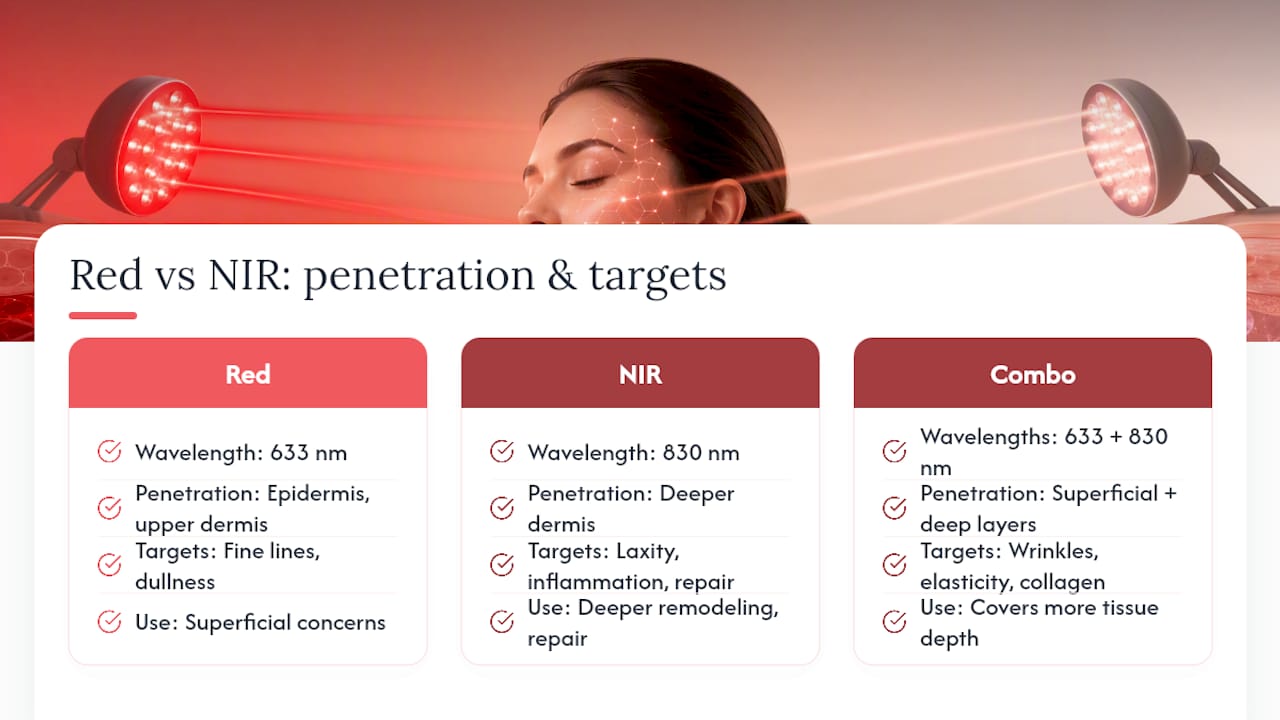
If your goal is superficial, like fine surface lines or a dull complexion, red light alone may get you there. If you’re dealing with deeper laxity, slow-healing tissue, or inflammation that sits below the surface, near-infrared is doing the heavier lifting. That’s not a strict either-or choice, though. Plenty of clinical protocols use both wavelengths together, and for good reason.
A randomized trial combining 633 nanometer red light with 830 nanometer near-infrared, delivered biweekly for 20 minutes at 55 mW/cm² in the combined red and NIR clinical trial, reported measurable improvements in wrinkles, elasticity, and collagen density after three months. Combined regimens like this are common because red and NIR act on overlapping but not identical layers of skin. Pairing them covers more tissue depth in a single session, which is part of why most reputable multi-wavelength devices bundle both rather than isolating one or the other.
Is Near-Infrared Light Safe for Your Skin?
Near-infrared therapy has a strong safety record when used at controlled, nonthermal intensities, but “generally safe” doesn’t mean risk-free for everyone. A few side effects and precautions deserve real attention before you start.
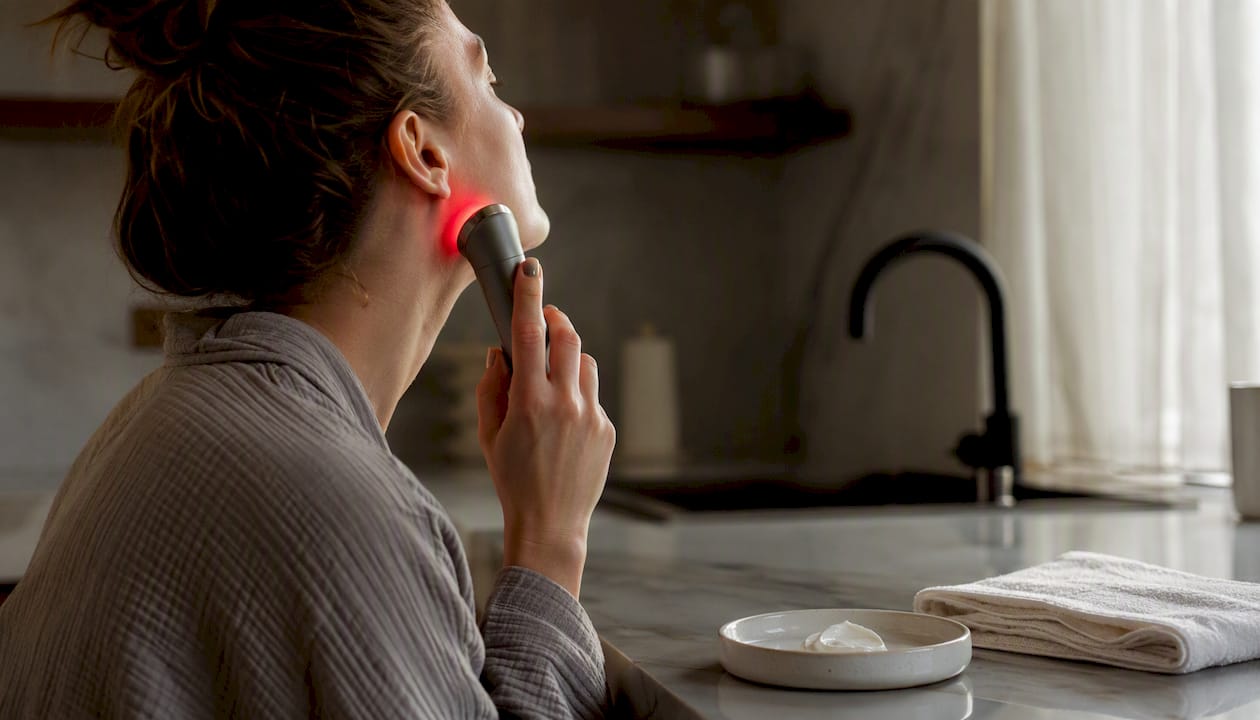
The most common side effect is transient redness, usually mild and resolving within hours. Rare but more serious risks involve thermal injury, and those cases almost always trace back to high-intensity sources or improperly calibrated equipment rather than standard low-level photobiomodulation devices. Some of the early reports of infrared-related skin damage came from studies using unrealistically high, heat-generating exposures, not the controlled, low-level light most modern devices are built around.
Run through this precaution checklist before your first session:
- Photosensitivity disorders or medications: certain drugs and skin conditions increase sensitivity to light exposure, so check with a doctor or pharmacist first.
- Active infections or open wounds: only use light therapy on these under professional supervision, not as a DIY fix.
- Pregnancy: there’s limited safety data specific to pregnancy, so treat this as a conversation for your doctor rather than an assumption.
- Darker skin tones: Harvard Health notes that visible light, including the red wavelengths often paired with NIR, can raise hyperpigmentation risk in darker skin. Start at the lowest effective dose and watch closely for changes in pigment.
- Eye protection: NIR is invisible but still capable of retinal harm at close range and high intensity. Use the protective eyewear that comes with the device, even if the light itself doesn’t feel bright.
- Device labeling: look for FDA clearance language, often shown as a 510(k) statement, on any device marketed for home use. Its absence isn’t automatically disqualifying, but it’s one more data point in a device’s favor.
Pro Tip: Take a baseline photo under consistent lighting before your first session. Hyperpigmentation and irritation both show up gradually, and a photo record catches subtle shifts your memory won’t.
How Do You Use Near-Infrared Light Safely at Home or in a Clinic?
Dosing is where most of the confusion around near-infrared therapy actually lives. Two devices can both claim “near-infrared” and deliver wildly different results because they differ in irradiance, not just wavelength. Before buying anything, check three specs: the wavelength in nanometers, the irradiance in mW/cm², and whether the manufacturer discloses the treatment area and session distance the irradiance was measured at.
Vague marketing copy is the biggest red flag here. If a product page talks about “clinical-grade technology” without a single number attached, that’s worth questioning. Trustworthy listings state their wavelength range, their irradiance at a specified distance, and often reference FDA clearance for the intended use.
| Wavelength band | Typical irradiance range | Suggested session window |
|---|---|---|
| Red light (620 to 700 nm) | 20 to 35 mW/cm² | 10 to 20 minutes, 3 times weekly |
| Near-infrared (760 to 1,400 nm) | 30 to 55 mW/cm² | 15 to 20 minutes, 2 to 4 times weekly |
| Combined red + NIR | 20 to 55 mW/cm² depending on wavelength | 20 minutes, biweekly to several times weekly |
These ranges reflect what’s been used across the trials referenced throughout this guide, not a universal prescription. Your specific device’s manual should always take precedence, since irradiance depends heavily on the distance between the light source and your skin.
- Confirm both wavelength and irradiance are listed before purchasing, not just one or the other.
- Favor consistent, moderate sessions over occasional high-intensity blasts.
- Track your sessions per week rather than relying on memory, since inconsistent use is one of the biggest reasons people don’t see results.
- If a device lacks any irradiance figure, treat that as a genuine red flag, not a minor omission.
Pro Tip: Irradiance drops sharply as you move a device away from your skin, following the inverse square law. Doubling the distance can cut the effective intensity to a quarter of what’s listed on the box, so keep the device at the manufacturer’s recommended distance rather than eyeballing it.
Why Does Light Intensity Matter More Than Total Exposure Time?
Here’s the part most people miss entirely: more light is not automatically better light. Near-infrared therapy follows what’s known as the Arndt-Schulz principle, a biphasic dose response where low irradiance may do essentially nothing, moderate irradiance triggers beneficial cellular activity, and high irradiance can actually inhibit repair or cause outright harm.
Research on near-infrared intensity identifies roughly 30 to 35 mW/cm² as a referenced beneficial range, an intensity that approximates the near-infrared levels naturally present in sunlight. That’s a useful mental anchor: your device doesn’t need to blast far beyond what skin already tolerates from a sunny afternoon. It needs to land in that sweet spot consistently.
- Below the sweet spot, cellular response is minimal. You might use the device faithfully and see little to no change, not because NIR doesn’t work, but because the dose was too weak to trigger the mitochondrial response.
- Within the sweet spot (roughly 30 to 35 mW/cm², with some trials showing benefit across a 15 to 55 mW/cm² range depending on the outcome measured), ATP production rises, collagen synthesis activates, and inflammatory markers calm down.
- Above the sweet spot, the same pathways that support repair can flip into inhibition, and at high enough intensity, thermal injury becomes a real risk rather than a theoretical one.
Referenced beneficial range: approximately 30 to 35 mW/cm², based on intensities that mirror natural sunlight exposure. Trials examining broader outcomes have reported effects across a 15 to 55 mW/cm² window, underscoring that the “right” number shifts somewhat depending on whether you’re targeting wound healing, texture, or hair regrowth.
For texture and fine-line goals, twice-weekly 20-minute sessions within that referenced range tend to align with what trials have used. If you have darker skin or you’re new to photobiomodulation altogether, starting more conservatively than that midpoint and increasing gradually is the safer path. Practitioners tracking irradiance and duration together consistently find that steady, modest exposure outperforms sporadic high-power sessions for remodeling outcomes, which tells you something important: this is a consistency game, not a power contest.
A few open questions remain in this field. Researchers still don’t agree on a universal dosing standard across skin types, exact session frequency for maximum collagen response hasn’t been nailed down, and long-term data beyond several months of use is still thin. Treat any single number here as a well-supported starting point, not gospel.
When Will You See Results From Near-Infrared Therapy?
Patience matters more than most product pages admit. Based on trial data, initial cellular changes, like increased ATP activity and early collagen signaling, begin within the first few weeks of consistent use. Visible or histologically confirmed changes generally take longer.
The six-month daily far-infrared trial referenced earlier in this collagen and elastin research showed its most significant texture improvements, in the 25 to 50 percent range, after sustained treatment over months, not days. Other trials using combined red and NIR light reported measurable wrinkle and elasticity improvement around the three-month mark. A reasonable expectation window across the evidence is: subtle changes within 4 to 8 weeks, and clearer clinical or histologic improvement somewhere between 8 and 24 weeks of consistent use.
What should you actually expect to see improve?
- Texture smoothing: gradual, usually noticeable to you before it’s obvious to others.
- Fine line reduction: modest, cumulative change rather than a dramatic before-and-after.
- Wound healing speed: often one of the more measurable, faster-appearing benefits.
- Hyperpigmentation: don’t expect improvement here. The evidence consistently shows this isn’t where NIR delivers.
Track your own progress the same way trials do: a photo diary shot under identical lighting every one to two weeks beats relying on your memory of how your skin looked a month ago. If you’re not seeing any change after two to three months of consistent, correctly dosed use, that’s the point to loop in a dermatologist rather than simply upping the intensity on your own.
Should You Use an At-Home NIR Device or Get Professional Treatment?
At-home devices and in-clinic systems solve different problems, and the honest answer is that most people benefit from thinking of them as complementary rather than competing options.
At-home devices offer real accessibility: no appointments, lower cost per session over time, and irradiance levels calibrated for safe, unsupervised use. The tradeoff is power. Harvard Health notes that home devices are typically less powerful than clinical-grade systems, which means they’re built for consistent, gradual maintenance rather than dramatic, one-session transformation. In-clinic systems bring higher output, protocols tailored to your specific skin, and a clinician who can adjust course if something isn’t working, at a higher price point and with less convenience.
- At-home devices: accessible, lower cost over time, safer irradiance ceilings, best for maintenance and mild to moderate concerns.
- In-clinic systems: higher power, professional oversight, tailored protocols, better suited to significant skin laxity or complex scarring.
- Neither replaces the other outright for serious structural concerns. At-home NIR is a genuine complement to professional care, not a substitute for it when deeper intervention is needed.
A simple way to map your goal to your approach: light wrinkle smoothing and general maintenance fit an at-home device well. Visible skin laxity or a desire for lift and firmness usually calls for in-clinic evaluation, sometimes alongside a home device for upkeep between visits. Active wound care or anything involving broken skin belongs under clinician supervision, full stop. And regardless of which path you choose, check for FDA clearance guidance from the American Academy of Dermatology before trusting any home device’s efficacy claims. A 510(k) clearance doesn’t guarantee dramatic results, but its absence should make you read the marketing copy more skeptically.
What I’ve Learned Weighing the Hype Against the Data
Most of what gets written about near-infrared therapy falls into one of two camps: breathless enthusiasm that treats it like a miracle wand, or dismissive skepticism that lumps it in with wellness fads that have no mechanism behind them. Neither take holds up once you actually read the trials.
The mitochondrial mechanism behind NIR is legitimate biology, not marketing invention, and the clinical signals for texture, wound healing, and inflammation are consistent enough across independent studies to take seriously. What gets lost in translation is the dosing conversation. Most people assume more light equals more benefit, and that assumption is exactly backwards according to the Arndt-Schulz curve. The sweet spot is narrower than the marketing suggests, and blasting your skin at maximum intensity because you’re impatient for results is more likely to blunt the benefit than accelerate it.
The other underappreciated point: NIR works best as one piece of a broader skin health routine, not a replacement for the fundamentals. Sun protection, hydration, and a sensible topical regimen still do most of the heavy lifting for long-term skin health. Photobiomodulation adds a genuine, biologically grounded boost on top of that foundation. It doesn’t substitute for it. If you’re looking for a home device that reflects this evidence-based approach, one built around multiple wavelengths and calibrated irradiance, like the devices in Soneda’s lineup, gives you a way to apply this science consistently without guessing at your own dosing. For anything beyond mild to moderate concerns, or if you’re managing a medical skin condition, pairing that home routine with a dermatologist’s input is still the smarter long game.
A Home Device Built Around the Specs That Actually Matter
Everything covered above points to one practical conclusion: the devices worth trusting are the ones that publish real wavelength and irradiance numbers, not just marketing adjectives. Soneda’s Soneda Sculpt2 EMS facial toning device applies exactly that thinking, combining triple-wavelength LED therapy with EMS toning so you’re not relying on light alone to do the work.

If your goal extends beyond light therapy into visible lifting and firming, Soneda’s VividLift HIFU device pairs High-Intensity Focused Ultrasound with sonophoresis to support deeper collagen remodeling, the same dermal layer near-infrared light is working to influence. Clinical testing behind the VividLift line reports a 175 percent increase in skin hydration, and Soneda backs every device with a 100% money-back guarantee, so you can evaluate it against your own skin without financial risk. If you’ve read this far and want a device that treats dosing and wavelength specs as seriously as the research does, start by checking how the VividLift works and see if it fits into the routine you’re building.
Sources
- Near-infrared (NIR) photobiomodulation stimulates mitochondrial cytochrome c oxidase and downstream repair pathways
- Red light therapy for skin care - Harvard Health
- Near-Infrared Light and Skin: Why intensity matters
- Effects of infrared radiation on collagen and elastin production and clinical photo-aged skin outcomes (PMC2687728)