LED Wavelengths for Skin: What Each Color Actually Does

Blue light (≈400–470 nm) has the strongest clinical support for inflammatory acne. Red light (≈630–660 nm) leads the evidence for collagen stimulation and visible anti-aging results. Near-infrared (≈760–900 nm, often 810–830 nm) reaches deeper tissue and shows the best data for wound healing and calming inflammation. Green and yellow light show promise for pigmentation and redness, but the research base is thinner and less consistent.
Here’s the quick map, then we’ll get into why it works this way and how to apply it.
- Blue (~400–470 nm): Best evidence for inflammatory acne. Targets Cutibacterium acnes directly.
- Red (~630–660 nm): Best evidence for collagen stimulation, smoother texture, and reduced fine lines.
- Near-infrared (~760–900/810 nm): Penetrates deepest. Supports wound healing and works as an anti-inflammatory partner to red light.
- Green/yellow: Adjunctive at best right now. Some signal for pigmentation and superficial redness, but nowhere near as well studied.
One safety note before anything else: photosensitizing medications, unprotected eyes, and unrealistic expectations about at-home device power are the three most common mistakes people make with LED. At-home devices run at a fraction of the output used in clinical trials, so results take longer and the ceiling is lower than what you’ll read about in the studies backing this article. We’ll walk through exactly what that means for your routine.
Key Takeaways
The strongest evidence for LED wavelengths for skin maps blue light to acne, red light to collagen and anti-aging, and near-infrared to deeper repair and wound healing, with results depending heavily on consistent dosing over 8 to 12 weeks.
| Point | Details |
|---|---|
| Match wavelength to goal | Blue targets acne-causing bacteria; red builds collagen; near-infrared supports deeper repair and healing. |
| Dose matters more than color alone | Irradiance and fluence determine results, so check a device’s mW/cm² and J/cm² specs, not just its wavelength. |
| Consistency drives results | At-home devices need 8 to 12 weeks of regular sessions to approach outcomes seen in clinical trials. |
| Watch photosensitivity and phototype | Check medications, protect eyes, and patch-test darker skin tones before scaling up sessions. |
| Combined wavelengths often outperform single ones | Blue plus red or red plus near-infrared frequently beats single-wavelength results, an approach reflected in Soneda’s multi-wavelength Sculpt2 device. |
This article is general information, not a substitute for advice from a qualified doctor. Consult a qualified healthcare professional about your own circumstances before acting on anything here.
Table of Contents
- How LED Wavelengths Work on Skin: The Photobiomodulation Basics
- Which LED Colors Work Best for Which Skin Concerns?
- How Do You Read LED Device Specs Like a Clinician?
- Is LED Light Therapy Safe for Everyone?
- Why Combine LED Wavelengths Instead of Using Just One?
- Where Soneda’s Approach Fits the Evidence
- How to Build an LED Routine for Your Specific Skin Goal
- Sources
How LED Wavelengths Work on Skin: The Photobiomodulation Basics
Every wavelength of light interacts with a different target in your skin, and that’s the entire reason color matters here, not just “more light equals more results.” The science behind this is called photobiomodulation, and it comes down to which molecules in your cells happen to absorb which wavelengths.
Red and near-infrared light get absorbed by an enzyme called cytochrome c oxidase, sitting inside your cells’ mitochondria. When that enzyme absorbs photons in the 630–900 nm range, it kicks up ATP production, the energy currency your cells run on. More available energy means fibroblasts, the cells responsible for building collagen, ramp up their output. This mechanism is well documented in a comprehensive 2024 review of photobiomodulation, which ties red and NIR exposure to measurable gains in skin texture, elasticity, and wound repair.
Blue light plays an entirely different game. It doesn’t target your cells directly, it targets bacteria. Cutibacterium acnes, the bacteria most responsible for inflammatory breakouts, produces natural compounds called porphyrins as a byproduct of its metabolism. Those porphyrins happen to absorb blue light strongly. When they do, they generate reactive oxygen species that damage the bacterial cell from the inside, reducing bacterial load without antibiotics. A PMC review of blue light acne trials documents this mechanism along with the resulting lesion reductions.
Three factors decide how deep any given wavelength travels and what it can realistically affect:
- Wavelength length. Shorter wavelengths like blue scatter quickly and mostly affect the skin’s surface, which is exactly why blue light works on surface bacteria but does little for deep collagen.
- Tissue absorption. Red and NIR wavelengths pass more efficiently through skin because they’re less absorbed by melanin and hemoglobin near the surface, letting them reach the dermis where collagen lives.
- Total dose delivered. Wavelength determines the type of effect. Irradiance and exposure time determine the size of that effect.
That third point trips up almost everyone shopping for a device. A red light panel and a red light mask can share the identical peak wavelength but produce very different results, because the dose delivered to your skin, not just the color, decides the outcome.
Which LED Colors Work Best for Which Skin Concerns?
Different wavelengths have different amounts of research behind them, and the strength of that evidence should shape how much you expect from each one.
Blue light and acne
Blue light in the 400–470 nm range has the most consistent randomized controlled trial support of any wavelength for a single indication: inflammatory acne. Trials generally run multiple sessions per week over several weeks, with lesion counts dropping progressively as bacterial load falls. The mechanism, porphyrin activation in C. acnes, has been replicated across multiple studies and trial designs, which is part of why dermatology has embraced blue light as a legitimate adjunct to topical acne treatment rather than a fringe therapy.
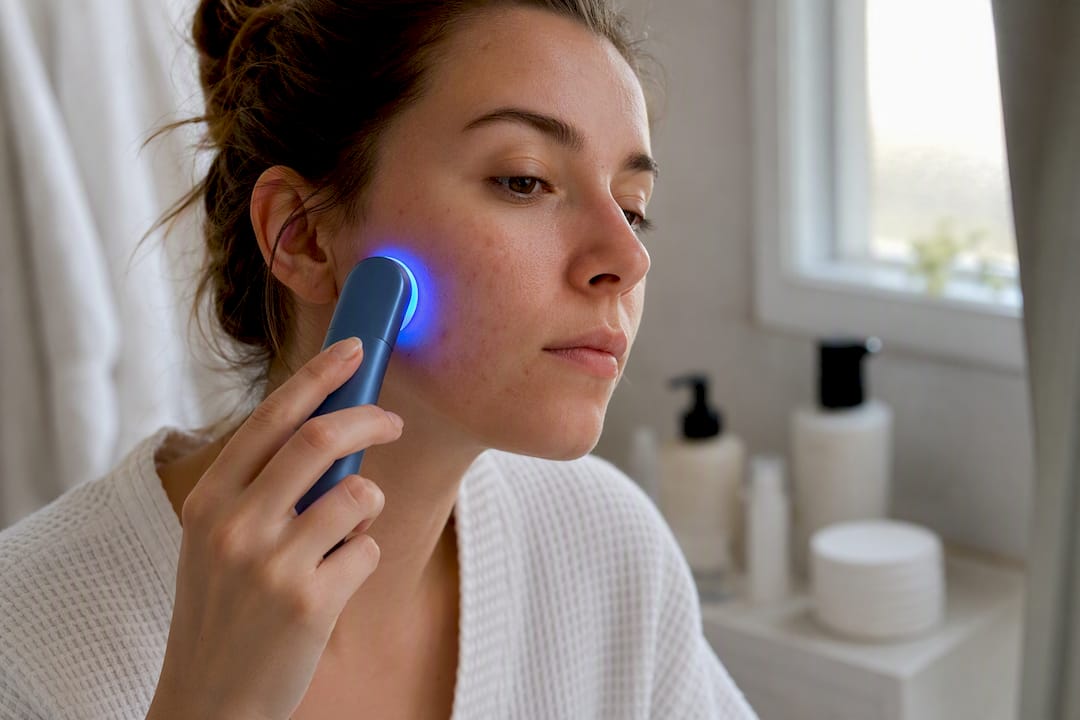
What blue light does not do particularly well is treat non-inflammatory acne, comedones, or scarring. It targets bacteria, not clogged pores or existing collagen damage. If your breakouts are mostly blackheads and whiteheads rather than red, inflamed bumps, blue light will underperform your expectations.
Red light and collagen
Red light in the 630–660 nm range has the deepest body of evidence for cosmetic anti-aging outcomes: measurable improvements in fine lines, skin roughness, and elasticity. This is where the “does red light shrink pores” question usually lands, too. Red light doesn’t shrink pore size directly. Pores don’t have muscles that contract. What it does is stimulate collagen production around the pore opening, which firms surrounding skin and can make pores look smaller over time. That’s a meaningful distinction, and it’s why “smoother, tighter-looking skin” is a more accurate claim than “smaller pores.”
Clinical trials for red light typically apply photobiomodulation multiple times per week across 8 to 12 weeks before evaluators see statistically significant changes in wrinkle depth or skin texture, according to findings summarized in the photobiomodulation review. Device-based research using specific systems with peak wavelengths around 633 nm has shown favorable outcomes for photoaging in a broader review of LED phototherapy applications, reinforcing that consistent, repeated exposure, not a single session, drives the visible change.
Study heterogeneity is a real limitation here. Trial protocols vary in fluence, session length, and total treatment duration, and a PubMed-indexed review of LED phototherapy flags exactly this as a reason to interpret headline results with some caution, especially when translating clinical outcomes to lower-powered consumer devices.
Near-infrared and deeper repair
Near-infrared, generally 760–900 nm and frequently delivered around 810 to 830 nm in commercial systems, penetrates deeper into tissue than either blue or red light. That depth is why NIR shows up most often in wound healing research and as an anti-inflammatory tool, and why it’s frequently paired with red light rather than used alone for skin rejuvenation. Device studies using an 830 nm peak have reported favorable outcomes for wound healing and photoaging markers, per the device-based LED phototherapy review.
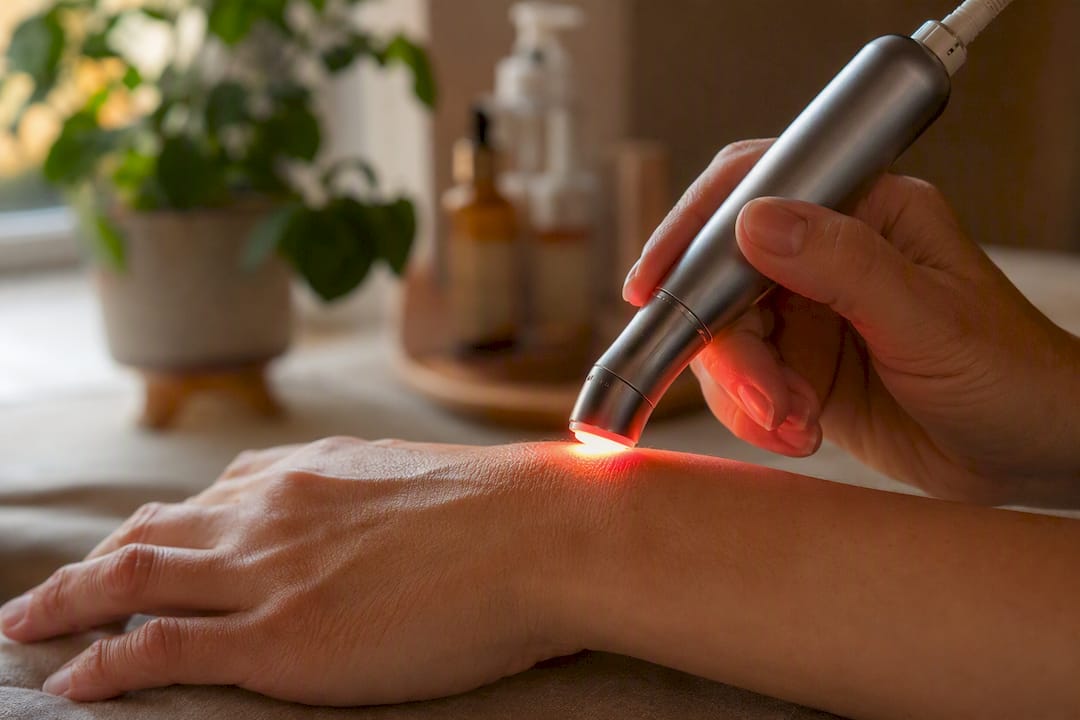
There’s also a hair growth angle worth knowing about if thinning hair is part of your concern list. Low-level light therapy using red and near-infrared wavelengths, including devices operating around 655 nm, has shown increases in terminal hair counts in randomized trials after consistent multi-week use, based on data compiled in a PubMed-indexed RCT on LLLT and hair growth. This isn’t the primary skin concern most readers land on this topic for, but if you’re already running a red/NIR routine for your face, the scalp benefit is a legitimate secondary payoff worth knowing about.
Green and yellow light: promising, not proven
Green and yellow wavelengths get marketed heavily for pigmentation and redness, but the evidence base is considerably thinner than what exists for blue, red, or NIR. Some smaller studies suggest green light may calm superficial redness and yellow light may have mild effects on pigment-related discoloration, but neither has the volume of randomized controlled trials that back the other three wavelengths. Treat claims about green light therapy for skin tone as an emerging, adjunctive idea rather than a primary treatment strategy, and if pigmentation is your main concern, pair realistic expectations with proven approaches like sun protection and topical treatments.
How Do You Read LED Device Specs Like a Clinician?
Two numbers separate a device that can plausibly replicate clinical results from one that’s mostly a feel-good glow: irradiance and fluence.
Irradiance is the power density hitting your skin, measured in milliwatts per square centimeter (mW/cm²). Think of it as how intensely the light is shining at any given moment.
Fluence (sometimes called dose) is the total energy delivered over an entire session, measured in joules per square centimeter (J/cm²). Fluence is what actually determines whether a biological effect occurs, and it’s calculated from irradiance multiplied by exposure time.
The practical relationship: session time in seconds equals your target J/cm² divided by (mW/cm² ÷ 1000). If a device outputs low irradiance, you need proportionally longer exposure to reach the same fluence a stronger device delivers in less time. Most people never do this math, which is exactly how a five-minute session on an underpowered mask ends up delivering a fraction of what a clinical trial protocol used.
Here’s what to actually check before trusting a product’s marketing copy:
- Peak wavelength vs. bandwidth. A spec sheet listing “630 nm” is describing the peak output. Real LEDs emit a spread, or bandwidth, around that peak. A tight bandwidth centered accurately on a clinically studied wavelength is a better sign than a vague “red light” label with no number attached.
- Irradiance range. Consumer LED masks and handhelds commonly output somewhere in the range of 5 to 80 mW/cm², while clinical systems used in trials often run considerably higher, according to comparative device parameter data.
- Session-level fluence. Home devices often deliver lower energy per session compared to the higher therapeutic fluences cited in some photobiomodulation trials for certain outcomes. That gap is exactly why home results build gradually rather than mirroring in-office results after a handful of uses.
- Distance and coverage. Irradiance drops sharply as distance from the skin increases, so a mask worn flush against the face delivers meaningfully more dose than a panel positioned a foot away, even with identical rated output.
Pro Tip: If a product page lists wavelength but not irradiance or fluence, that’s a gap worth noticing. Reputable devices, and the best LED light therapy devices on the market generally do, publish both numbers because they back up the claim rather than hide behind a vague color name.
None of this means lower-powered devices are useless. It means your timeline needs recalibrating. A device running at consumer-level irradiance can still produce real change, it just needs more sessions over more weeks to accumulate a comparable total dose to what a clinical trial delivered in a shorter window.
Is LED Light Therapy Safe for Everyone?
LED phototherapy has a strong overall safety record, but “safe for most people” isn’t the same as “safe with no exceptions,” and a few groups need to slow down before starting a routine.
Photosensitizing medications are the biggest interaction risk. Certain oral acne medications, tetracycline-class antibiotics, and some topical treatments increase your skin’s sensitivity to light, and combining them with LED exposure can raise the risk of irritation or a stronger-than-expected reaction. Harvard Health’s overview of LED therapy safety specifically recommends checking your current medications and topicals with a clinician before starting sessions, and this applies whether you’re using red, blue, or NIR wavelengths.
Most side effects that do occur are mild and temporary: brief redness, a warm sensation, or slight dryness that resolves within hours. Serious adverse events are rare in the published literature, which is a large part of why LED has become a mainstream adjunct treatment rather than staying confined to specialty clinics.
Darker skin tones need a slightly different approach, not avoidance. Visible light, particularly blue and green wavelengths, can trigger post-inflammatory hyperpigmentation in deeper Fitzpatrick phototypes if sessions are too frequent or too intense too soon. The safer path is a short, low-frequency test exposure on a small patch of skin, followed by a two to four week observation window before scaling up to a full routine. This isn’t a reason to skip LED, it’s a reason to introduce it gradually.
A few other guardrails worth building into any routine:
- Protect your eyes. LED devices, especially blue and NIR panels, should be used with the manufacturer’s protective eyewear or with eyes closed and shielded, since direct or repeated exposure to concentrated light near the eyes carries real risk over time.
- Check active retinoid or benzoyl peroxide use. These ingredients already increase photosensitivity on their own, and stacking them with LED sessions without spacing them out can compound irritation.
- Patch-test new devices. Especially for anyone with a history of melasma, active dermatitis, or a photosensitivity disorder, before committing to a full-face routine.
- Stop and consult a dermatologist if you notice unusual darkening, persistent redness beyond a day, or blistering, none of which are expected outcomes from correctly used LED therapy.
Why Combine LED Wavelengths Instead of Using Just One?
Single-wavelength protocols work, but combining wavelengths is where a lot of the more compelling clinical data actually lives, and it’s worth understanding the logic before assuming more colors just means more marketing.
- Blue plus red for acne. Blue light knocks down bacterial load while red light calms the inflammation and supports healing of already-damaged tissue. Several studies comparing combined protocols to single-wavelength blue treatment report better lesion reduction with the combination, since the two wavelengths are addressing separate parts of the acne process rather than duplicating each other’s work.
- Red plus near-infrared for rejuvenation. Red light stimulates the surface-level fibroblast activity, while NIR reaches deeper structures and adds an anti-inflammatory effect that supports the same collagen-building process from underneath. This layering is one reason multi-wavelength panels have become the standard in newer at-home devices rather than single-color masks.
- Photodynamic therapy for stubborn cases. In-office PDT applies a photosensitizing agent, typically aminolevulinic acid, before light exposure to dramatically amplify the reaction in target cells. It’s a more aggressive, clinician-supervised option generally reserved for acne or sun-damage cases that haven’t responded well to standard light therapy or topicals alone.
“Combined-wavelength protocols and photodynamic therapy often show broader or superior outcomes for acne and photoaging compared to single-wavelength approaches,” according to a review of LED phototherapy applications covering multiple device studies and treatment combinations.
Combining LED with other skin technologies follows the same logic. Sonophoresis, which uses ultrasound waves to temporarily increase skin permeability, can help topical serums absorb more effectively right after an LED session, since the two work on different problems: one delivers light energy to cells, the other opens a better path for active ingredients to actually reach them. EMS facial toning adds a third, entirely mechanical layer, stimulating muscle contraction rather than working through light or absorption at all. None of these technologies substitute for each other. They complement each other by hitting the skin through three separate mechanisms.
Where Soneda’s Approach Fits the Evidence
Soneda’s device engineering reflects the same layered logic the research points to: no single wavelength or technology does everything, so pairing them is where results compound. The Sculpt2 EMS Facial Toning Device combines multiple LED wavelengths with infrared and EMS in one device, mirroring the combined-protocol rationale that shows up repeatedly in the clinical literature rather than relying on a single color to do the whole job.
A few things worth stating plainly, since transparency matters more than marketing polish here. Soneda’s internally reported 100% user satisfaction rate and 175% increase in skin hydration are company-generated figures from customer feedback and internal testing, not independent peer-reviewed data, and we’d encourage anyone evaluating those numbers to look at them as brand-reported outcomes rather than clinical trial results. That distinction is worth keeping in mind for any at-home device brand, not just this one.
What we can say with more confidence is that the underlying approach, pairing light therapy with sonophoresis for enhanced absorption, lines up with how dermatology researchers already think about combined modalities. A few practical notes if you’re evaluating a multi-wavelength device:
- Check whether the device specifies actual wavelengths (in nm) rather than vague color names alone.
- Look for irradiance or session-time guidance so you can gauge realistic dosing.
- Favor devices pairing red/NIR with a complementary technology like sonophoresis if your goal is firmness and hydration together, not light alone.
Pro Tip: Treat brand-reported satisfaction and hydration statistics as directional evidence of consumer experience, and treat peer-reviewed wavelength research as your baseline for what’s biologically plausible. Both matter, but they’re answering different questions.
How to Build an LED Routine for Your Specific Skin Goal
Building a routine that actually works starts with picking your wavelength based on your primary concern, not on whatever device happens to be on sale.
- Identify your primary goal first. If active breakouts are your main issue, start with blue light. If fine lines, texture, or firmness top your list, start with red. If you’re recovering from a procedure or dealing with persistent inflammation, near-infrared should lead, often alongside red.
- Factor in your phototype. If you have a deeper skin tone and are starting blue or green light for the first time, run a smaller test patch for two to four weeks before committing to full sessions, given the hyperpigmentation risk discussed earlier.
- Set a realistic session schedule. A common acne-focused approach uses blue light roughly three times a week with red light layered in as an anti-inflammatory adjunct. Anti-aging routines typically run red or combined red/NIR three to five times weekly. Both approaches need sustained use, generally 8 to 12 weeks, before meaningful change shows up.
- Track progress with more than a mirror. Photograph your skin under consistent lighting every two weeks. Inflammatory acne should show a visible drop in active lesions by week four to six if the wavelength and frequency are right for you. Texture and fine-line improvements from red/NIR protocols tend to lag further behind, often not becoming obvious until week eight or later.
- Know when to escalate. If you’ve run a consistent routine for 12 weeks with no measurable change, or if breakouts are worsening rather than improving, that’s a signal to consult a dermatologist rather than simply adding more sessions. Cystic or nodular acne, active infections, or diagnosed skin conditions like rosacea flare-ups generally need professional-grade treatment or prescription support alongside, not instead of, light therapy.
- Watch for red flags. Stop immediately if you notice blistering, unusual dark patches that don’t fade, or persistent pain during or after sessions. These aren’t typical LED reactions and warrant a clinician visit.
Pro Tip: Consistency beats intensity with every wavelength. A 10-minute session four times a week for three months will outperform a single hour-long session done once, because photobiomodulation is a cumulative, dose-dependent effect, not a one-time fix.
If your concern is redness or rosacea-adjacent sensitivity rather than acne or aging, red light’s anti-inflammatory profile tends to be gentler than blue, and it’s worth reading more on how red light interacts with rosacea-prone skin before starting. Similarly, anyone dealing with melasma or stubborn pigmentation should look closely at how LED interacts with melasma before adding blue or green light into a routine, since pigment-prone skin responds differently than skin dealing primarily with acne or aging.
Realistic Expectations for At-Home LED Use
Consistency beats intensity when you’re working with a device you can use in your own bathroom. A lower-powered mask used correctly, four times a week, for three straight months will outperform an expensive session skipped more often than it’s kept. Pair LED with the fundamentals: hydrated skin responds better to light therapy than dry, compromised skin, and daily sunscreen protects the very collagen gains you’re working to build.
Timing matters with actives. Space LED sessions apart from retinoid or benzoyl peroxide application, since both already increase photosensitivity, and doubling up same-night can lead to unnecessary irritation. If you’re managing a diagnosed skin condition or using a prescription-strength active, loop in a dermatologist before building light therapy around it. LED is a strong complement to a skincare routine. It isn’t a replacement for medical guidance when your skin already needs it.
Get an Evidence-Aligned LED Routine Without the Clinic Price Tag
In-office LED sessions with clinical-grade fluence deliver strong results, but they also mean recurring appointments and per-visit costs that add up fast over a 12-week protocol. Soneda’s approach puts a comparable multi-wavelength setup directly into your routine at home, without the driving, scheduling, or repeat billing.

The Sculpt2 EMS Facial Toning Device pairs multiple LED wavelengths with infrared and EMS toning, giving you the combined red/NIR rationale this article walked through in a single at-home tool rather than three separate purchases. If you’re building a routine around collagen support and firmness specifically, the VividLift HIFU + Sono device adds ultrasound-driven lifting and sonophoresis-enhanced absorption on top of light-based approaches, for readers who want more than wavelength therapy alone can offer.
Clinics still have a real place in this picture, particularly for higher-power protocols, photodynamic therapy, or cases involving diagnosed skin conditions that need direct supervision. But for building a sustainable, evidence-informed routine you can run consistently at home, preorder the Sculpt2 and start tracking your own progress against the timelines outlined above.
Sources
- Unlocking the Power of Light on the Skin: A Comprehensive Review on Photobiomodulation (PMC, 2024)
- LED phototherapy review (PubMed indexed review)