Rosacea Red Light: Is LED Therapy Right for You?

Red light therapy (also called photobiomodulation, or PBMT) is a clinically supported adjunct for many rosacea patients, particularly those with inflammatory or papulopustular subtypes. It won’t cure rosacea, but consistent use can meaningfully reduce redness, calm inflammatory flares, and support skin barrier repair. Harvard Health and the American Academy of Dermatology both recognize light-based therapies as legitimate components of a broader rosacea plan. If you’re on photosensitizing medications or have vascular-dominant disease with visible telangiectasia, consult a dermatologist before starting. Otherwise, a conservative at-home trial is a reasonable first step.
Table of Contents
- What does the research actually show for rosacea red light?
- How red and near-infrared light work on rosacea at the cellular level
- How does LED/PBMT compare with IPL, PDL, and other laser options?
- How to safely use red light therapy for rosacea at home or in clinic
- Who should avoid red light, and what are the real risks?
- How to fit red light into your full rosacea skincare routine
- Questions to ask your dermatologist before starting
- Key Takeaways
- A realistic perspective on at-home LED for rosacea
- Sonedaskincare’s at-home LED option for rosacea-prone skin
- Useful sources and further reading
What does the research actually show for rosacea red light?
The evidence is promising but not definitive. Human clinical observations report measurable improvements in erythema and inflammatory lesion counts when LED is used alongside standard drug therapy. A clinical observation published in Lasers in Medical Science found that LED added to medical therapy produced clinical improvement comparable to IPL in the sample studied, with combined regimens outperforming medication alone.
A PubMed-indexed protocol study described combined 590 nm and 830 nm sessions reducing rosacea signs when used as part of a combined regimen, with specific settings of 590 nm at 25 mW/cm² for 10 minutes and 830 nm at 50 mW/cm² for 10 minutes.
Preclinical data adds mechanistic weight. A PBMT mouse model study showed significant reductions in erythema scores, inflammatory cell infiltration, and key markers including S100A9, p65, and the angiogenesis marker CD31 after PBMT treatment.

The honest caveat: a PMC review of light-based treatments flags heterogeneous device settings, inconsistent outcome measures, and small sample sizes across studies. No standardized dosing protocol exists yet.
| Study Type | Reported Outcome | Evidence Strength |
|---|---|---|
| Human clinical observation (LED + drug therapy) | Improved erythema and lesion counts vs. drug alone | Moderate |
| Human LED protocol (590 nm + 830 nm) | Reduced rosacea signs in combined regimen | Moderate |
| Mouse PBMT model (590 nm + 830 nm) | Reduced erythema, S100A9, p65, CD31 | Preclinical only |
| Systematic/narrative reviews | Variable outcomes; calls for standardized trials | Limited (heterogeneous) |
Evidence strength callout: Current evidence is moderate for adjunctive benefit in inflammatory rosacea and limited for standalone or curative use. Animal data supports the mechanism; human trials need larger, randomized designs.
How red and near-infrared light work on rosacea at the cellular level
PBMT reduces inflammation and supports barrier and collagen repair primarily by stimulating cytochrome c oxidase in mitochondria, which boosts cellular energy production and triggers downstream anti-inflammatory signaling. Think of it as a cellular reset: light energy absorbed by skin cells shifts them away from an inflammatory state.
The specific mechanisms relevant to rosacea include:
- Downregulation of S100A9 and p65: Both are elevated in rosacea-like inflammation; PBMT suppresses them, as shown in the mouse model research.
- Decreased CD31 expression: — CD31 marks new blood vessel formation (angiogenesis). Reducing it may slow the progressive vascular changes that worsen rosacea over time.
- Collagen and keratinocyte support: Red light stimulates fibroblasts to produce collagen, which strengthens the skin barrier and helps reduce the fragility that makes rosacea skin so reactive. For more on stimulating collagen production, the mechanism overlaps directly with what PBMT delivers.
Wavelength determines how deep the light penetrates. Visible red (630–670 nm) targets the upper dermis where inflammatory cells cluster. Near-infrared (810–850 nm and up to 940 nm) reaches deeper vascular structures. That’s why dual-wavelength protocols tend to outperform single-wavelength approaches in the clinical observations reviewed.
How does LED/PBMT compare with IPL, PDL, and other laser options?
The core difference is thermal vs. non-thermal. PBMT delivers low-level light that triggers biological responses without heating tissue. IPL (intense pulsed light) and PDL (pulsed dye laser) work through photothermolysis, selectively heating and destroying blood vessels. Both have a place in rosacea care, but they serve different purposes.
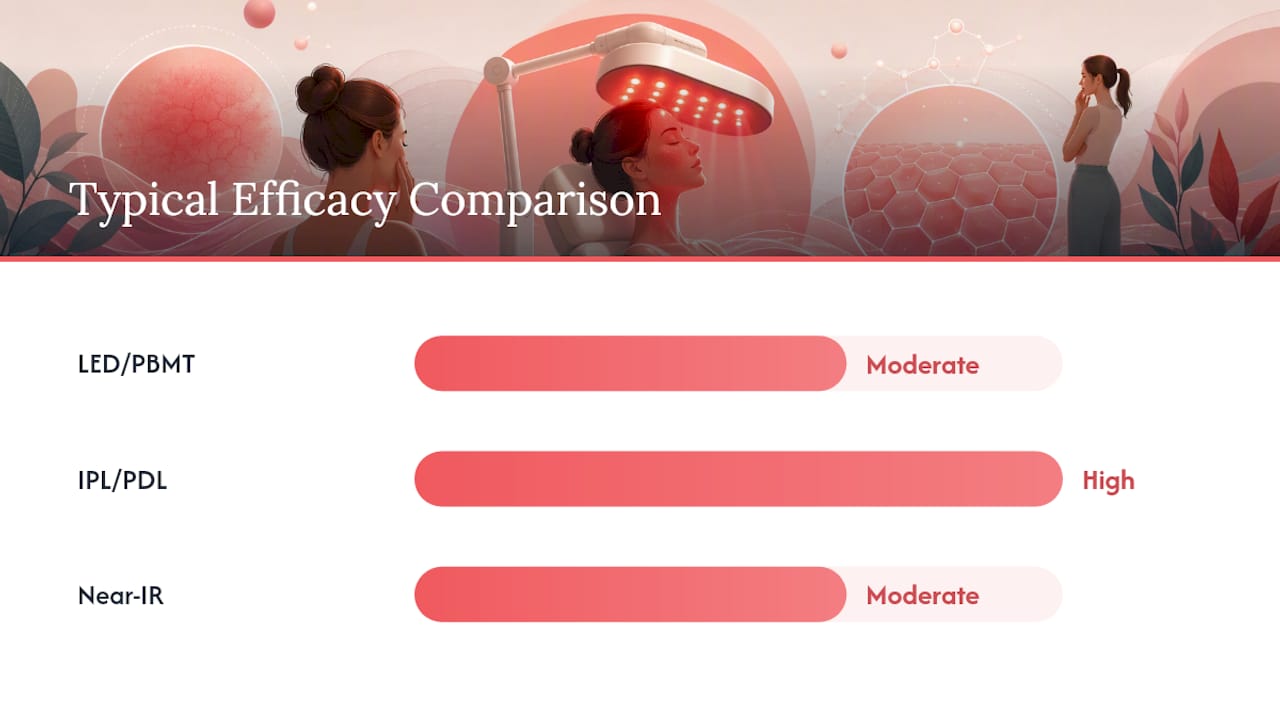
| Modality | Mechanism | Best For | Typical Efficacy | Downtime | Treatment Interval |
|---|---|---|---|---|---|
| Low-level LED/PBMT | Non-thermal anti-inflammatory modulation | Inflammatory/papulopustular rosacea, barrier support | Moderate improvement in redness and lesions | None | 3x/week ongoing |
| Vascular-selective lasers/IPL | Photothermolysis of blood vessels | Persistent telangiectasia, erythematotelangiectatic (ETR) subtype | High for visible vessels | 1–5 days redness/bruising | Every 4–6 weeks |
| Near-infrared deep-penetration devices | Deeper tissue anti-inflammatory + collagen | Diffuse redness, barrier repair, combination protocols | Moderate | None to minimal | 3x/week |
The AAD notes that vascular-selective therapies are the most studied for telangiectasia and persistent erythema, while PBMT plays a supportive, less destructive role. Mayo Clinic adds that treated vessels may not reappear, but new ones can form over time, which is why ongoing maintenance matters.
Key scenarios to guide your choice:
- Papulopustular rosacea: — PBMT as an adjunct to topical or oral therapy.
PBMT is slower and unlikely to eliminate visible broken capillaries on its own. That’s not a weakness; it’s a different job.
How to safely use red light therapy for rosacea at home or in clinic
Start conservative. The recommended wavelength windows are visible red at 630–670 nm and near-infrared at 810–850 nm. For rosacea-prone skin with vascular sensitivity, NIR at 810–850 nm is often preferable because it penetrates deeper with less surface heat. Avoid blue or green light modes if your device has them; they can aggravate rosacea.
Practical protocol:
- Start short: Begin with 5–8 minute sessions. Do not start at maximum intensity or duration.
- Distance: For panel devices, position 25–30 cm from your face. For masks, follow the manufacturer’s specifications.
- Frequency: Three sessions per week is a standard starting point.
- Ramp-up: After 2–4 weeks with no adverse reaction, you can gradually increase session length or frequency.
- Trial length: Allow a minimum of 6–8 weeks before judging whether the therapy is working. Visible improvement in redness and lesion frequency typically appears in this window, consistent with clinical observations using combined LED protocols.
- Track your response: Keep a brief daily log noting redness level, any post-session flushing, and lesion count.
What to watch for:
- Transient warmth during or immediately after a session is normal.
- Flushing that resolves within 30–60 minutes is generally acceptable.
- Prolonged redness beyond 2 hours, or a worsening baseline over days, signals you need to reduce intensity or consult a clinician.
At-home LED devices range widely in price. Clinical in-office PBMT or LED sessions typically cost more per session but are supervised. For a practical overview of at-home red light therapy devices, device quality and wavelength accuracy vary significantly across the market.
Who should avoid red light, and what are the real risks?
Red light therapy has a strong safety profile, but rosacea skin is reactive by nature. Know the contraindications before you start.
Clear contraindications:
- Active photosensitive disorders such as lupus or porphyria.
- Current use of photosensitizing medications (common examples: doxycycline, isotretinoin, certain antihistamines, and some topical retinoids). Check with your prescribing physician.
- Active severe inflammation, open lesions, or a current rosacea flare. Wait until the acute phase settles.
- Recent use of photosensitizing topicals (St. John’s Wort extracts, certain essential oils) in the treatment area.
Common mild side effects:
- Temporary redness or warmth immediately after a session, usually resolving within an hour.
- Mild tingling, which often decreases as skin adapts over the first few weeks.
Signs of a problematic response:
- Persistent redness lasting more than 2 hours post-session.
- Baseline redness or lesion count worsening over a 1–2 week period.
- New or increased burning sensation that doesn’t settle between sessions.
Safety checklist:
- Always start at the lowest available intensity setting.
- Wear the eye protection provided with your device; never look directly into LED panels.
- Avoid blue and green light modes on multi-wavelength devices if you have rosacea.
- Keep a treatment diary to track changes objectively.
- Do not use immediately after applying active topicals (retinoids, AHAs, BHAs).
Pro Tip: If you experience a post-treatment flush lasting more than 2 hours, or if your baseline redness worsens over consecutive sessions, reduce session duration by half and switch to longer NIR wavelengths (830–940 nm) rather than stopping entirely. Then consult your dermatologist before resuming.
How to fit red light into your full rosacea skincare routine
Red light is adjunctive. It complements topical or oral medications and sun protection; it does not replace them. The National Rosacea Society positions light-based options as part of a broader medical plan, not a standalone solution.
Sequencing matters:
- Perform LED sessions on clean, product-free skin. Remove all makeup, sunscreen, and active topicals before treatment.
- Avoid applying retinoids or strong actives (AHAs, BHAs, benzoyl peroxide) immediately before or after a session unless your dermatologist has cleared the combination.
- After a session, apply a gentle, fragrance-free moisturizer. SPF is non-negotiable during the day.
Practical dos and don’ts:
- Do document your skin weekly with consistent lighting and camera angle. Objective tracking is the only reliable way to judge benefit.
- Do continue prescribed topicals (metronidazole, azelaic acid, ivermectin) on their normal schedule. LED does not interfere with these.
- Don’t add multiple new skincare variables at the same time as starting LED. Isolate the variable so you know what’s working.
- Don’t use LED during an active flare triggered by a known irritant. Address the trigger first.
Rosacea subtypes most likely to benefit from combined therapy:
- Papulopustular (inflammatory): strongest adjunctive evidence.
- Erythematotelangiectatic with diffuse redness (no prominent vessels): moderate benefit for background redness.
- Post-procedure recovery (after IPL or PDL): PBMT may support healing and reduce post-treatment inflammation.
Questions to ask your dermatologist before starting
Bring this list to your next appointment. It will make the conversation more efficient and help you get a personalized protocol rather than generic advice.
- “Does my rosacea subtype make me a good candidate for LED/PBMT?” Papulopustular and diffuse erythema subtypes tend to respond better than telangiectasia-dominant disease.
- “Are any of my current medications or supplements photosensitizing?” This is critical before starting any light therapy.
- “Which wavelength and device type do you recommend for my skin?” Ask specifically about 630–670 nm vs. 810–850 nm and whether a mask or panel suits your needs.
- “How will we measure improvement?” Agree on an objective metric (erythema score, lesion count, photography) before you start.
- “Should I pause LED sessions before or after any planned IPL or PDL treatments?” Overlapping modalities without guidance can increase the risk of over-treatment.
- “Are there any topicals in my current routine I should avoid using on treatment days?”
Red-flag answers that should prompt caution:
- Your clinician advises against any visible-light therapy without a clear reason specific to your case.
- You’ve had adverse reactions to light-based treatments in the past (beyond expected transient redness).
- You are currently taking a systemic photosensitizer and your prescribing physician hasn’t cleared light therapy.
The AAD and rosacea.org both support dermatologist-guided light therapy as part of a structured treatment plan.
Key Takeaways
Red light therapy is a clinically supported adjunct for inflammatory rosacea, most effective when combined with medical therapy and used consistently over a minimum of 6–8 weeks.
| Point | Details |
|---|---|
| Adjunctive, not curative | PBMT reduces redness and inflammation but works best alongside topical or oral rosacea medications. |
| Best-fit subtype | Papulopustular and diffuse erythema subtypes show the strongest response; telangiectasia-dominant disease needs vascular lasers/IPL first. |
| Safe starting protocol | Use 630–670 nm or 810–850 nm, 5–8 minutes, 3x/week; ramp up only after 2–4 weeks with no adverse reaction. |
| Key safety caution | Avoid light therapy if on photosensitizing medications; stop if post-session flushing exceeds 2 hours or baseline worsens. |
| Sonedaskincare LED option | The Soneda Lumira and Sculpt2 devices offer multi-wavelength LED therapy suited to an adjunctive at-home protocol for rosacea-prone skin. |
A realistic perspective on at-home LED for rosacea
The most common mistake people make with LED therapy for rosacea is expecting a dramatic result in the first two weeks, then abandoning the device when their skin looks the same. The evidence doesn’t support quick fixes here. What it does support is gradual, cumulative improvement when you use the right wavelengths consistently and pair them with a sensible skincare routine.
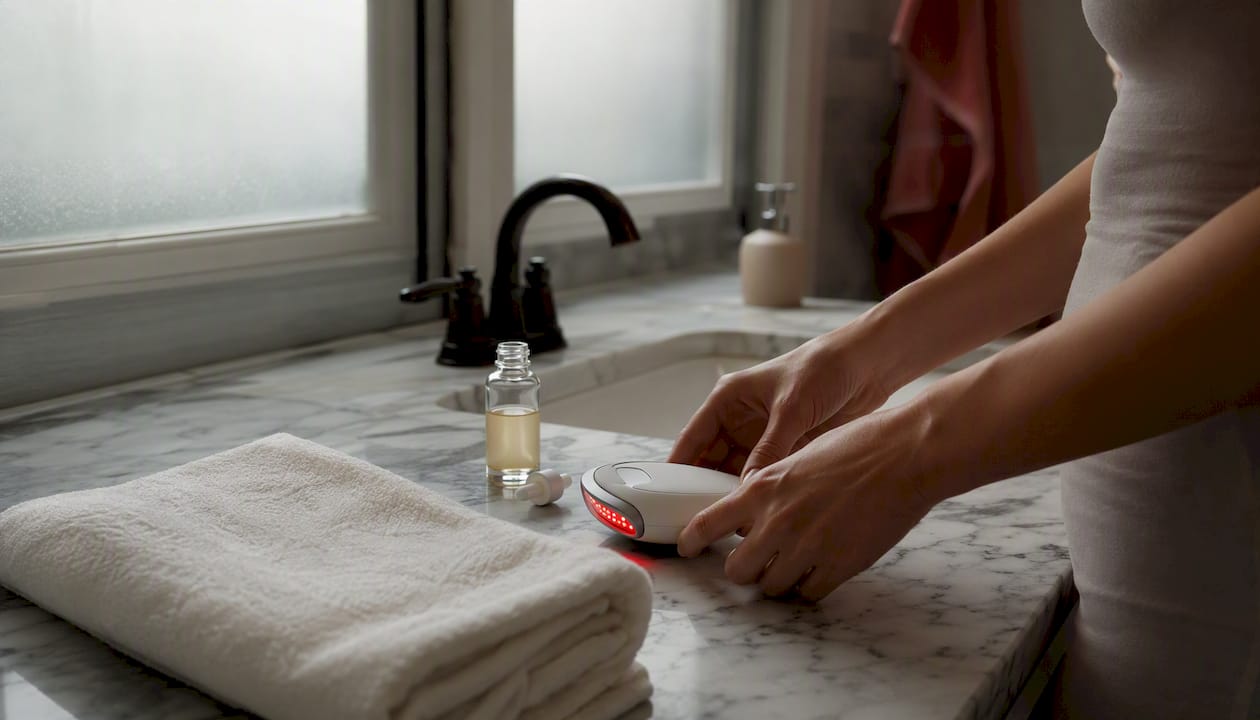
At-home devices have real limitations compared to clinical treatments. They operate at lower irradiance levels, which means longer timelines and more modest outcomes. That’s not a reason to dismiss them. For many people with inflammatory rosacea, a well-chosen home device used three times a week over two to three months produces a noticeable reduction in background redness and fewer flare days, without the cost or recovery time of in-office procedures.
What actually matters when choosing a device: wavelength accuracy (not just “red light” marketing claims), irradiance output, and whether the device avoids blue or green modes that can aggravate rosacea. Always check device specifications against the 630–670 nm and 810–850 nm windows the clinical literature supports. And keep your dermatologist in the loop, especially if you’re combining LED with prescription topicals or planning any clinic-based laser work.
Sonedaskincare’s at-home LED option for rosacea-prone skin
If you’re ready to add LED therapy to your rosacea routine, Sonedaskincare offers two multi-wavelength devices built for at-home use: the Soneda Lumira LED Face & Neck Mask and the Soneda Sculpt2 with Triple-Wavelength LED. Both are designed to fit the conservative, adjunctive protocol this article recommends: short sessions, clinically relevant wavelengths, and consistent use over weeks rather than days.
The Lumira mask covers the face and neck with four wavelengths, making it practical for the kind of full-face rosacea coverage that panel devices can miss. The Sculpt2 pairs LED with EMS facial toning for users who want to address both redness and skin firmness in one session. Neither device replaces medical care or a dermatologist’s guidance, but both are built to the standard that makes at-home LED a credible part of your routine.
View the full device range at Sonedaskincare and check device specs before purchasing to confirm wavelength compatibility with your protocol. If you have questions about which device fits your skin type, Sonedaskincare’s support team can help you choose.
This article is for general informational purposes only and is not a substitute for professional medical advice. Confirm your treatment plan with a licensed dermatologist or physician.
Useful sources and further reading
- Red light therapy for skin care — Harvard Health
- PMC article showing PBMT effects on rosacea-like mouse lesions
- PubMed record describing LED clinical observation with 590 nm + 830 nm
- Intense pulsed Light, Light-Emitting Diode, and hydroxychloroquine in the treatment of rosacea: A clinical observation | Lasers in Medical Science | Springer Nature Link
- Lasers and lights: How well do they treat rosacea? — AAD
- Rosacea — Symptoms and causes - Mayo Clinic