Over 100 mW/cm²? Red Light Eye Protection for Home Users

Whether you need eye protection depends on three things: your device’s power output, your distance from it, and whether it emits near-infrared (NIR) light alongside visible red. The simple rule: keep your eyes closed for low-power masks and body panels used at arm’s length, but wear opaque or wavelength-specific goggles for high-power, close-range panels or any device that emits NIR. ICNIRP’s guidance backs this up, and it is recommended to check your device’s actual irradiance at treatment distance before deciding.
TL;DR:
- Eye protection is most critical when using high-power panels within 12 inches, especially if they emit near-infrared light or exceed about 100 mW/cm² in irradiance.
- Most home-use devices with irradiance below 50 mW/cm² at treatment distance generally do not require goggles, but longer or closer sessions may warrant protection.
- The natural reflexes and eyelid tissues provide partial protection, but high-intensity, close-range NIR exposure still requires optical density rated goggles.
- Proper protective gear should be rated OD 3–4 for visible red wavelengths and OD 4–5 or higher for near-infrared, with spectral transmission charts confirming actual protection.
- Always verify your device’s actual irradiance at your intended distance and its spectral output before deciding on eye safety measures.
Table of Contents
- When Red Light Eye Protection Actually Matters
- Why Closed Eyelids Aren’t a Complete Shield
- Choosing the Right Eye Protection: OD, Fit, and Coverage
- Safety Steps for Every Device Type
- Warning Signs and What to Do After Exposure
- A Practical Checklist for Choosing a Safer Device
- Our Take: Stop Guessing, Start Checking Your Specs
- Sources
When Red Light Eye Protection Actually Matters
Not every red light session calls for goggles. The deciding factor is irradiance, measured in milliwatts per square centimeter (mW/cm²), at the exact distance you use the device.
Practical safety guides generally sort irradiance into three bands, and each maps to a different level of caution:
- Under 50 mW/cm²: Usually fine with closed eyes. Most LED face masks and body panels used at a normal distance fall here.
- 50 to 100 mW/cm²: Worth considering goggles, especially for direct face treatments or longer sessions.
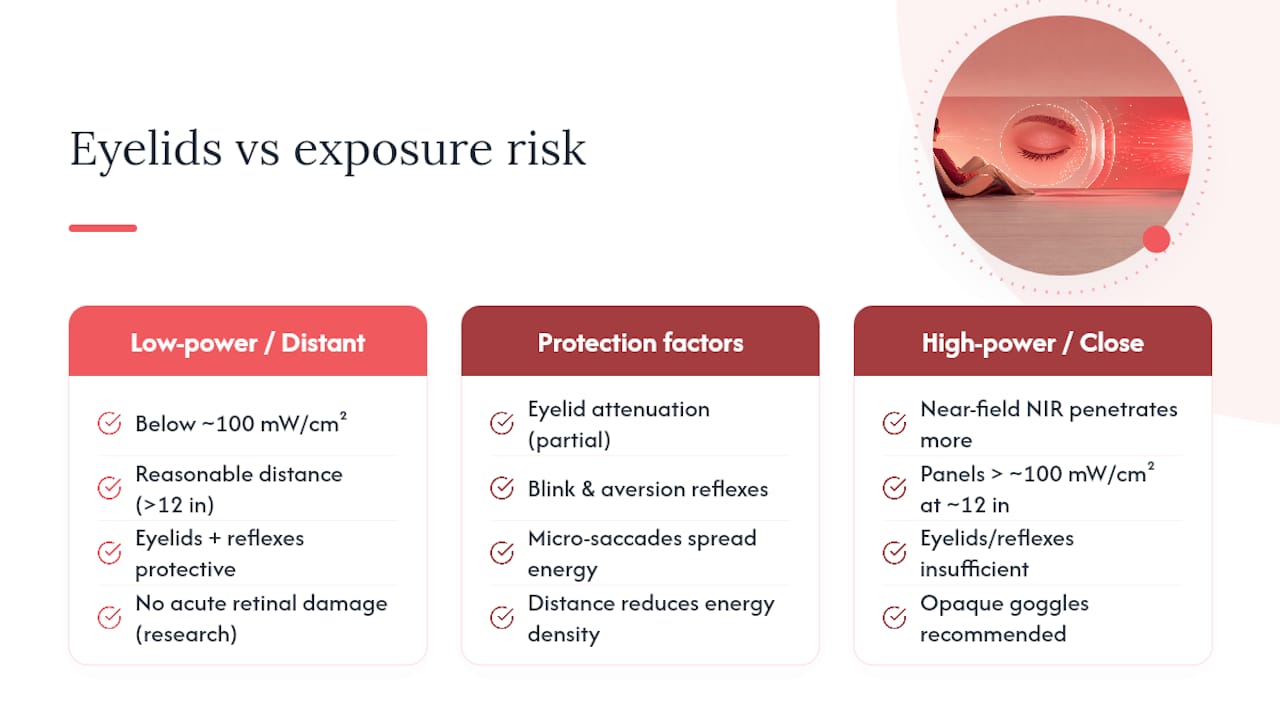
- Over 100 mW/cm²: Goggles are recommended, particularly at close range. ICNIRP notes that panels exceeding roughly 100 mW/cm² within about 12 inches of the face call for opaque protection, while treatments done 2 to 4 feet away typically deliver under 15 mW/cm² to the eyes.
Device type gives you a rough starting point, though it’s never a substitute for checking the spec sheet. LED masks tend to run low-power by design, since the panels sit close to skin but are engineered with output limits in mind. Handhelds vary more. Some stay gentle, others push into medium territory when held directly against skin. Consumer panels used for full-body sessions often land in the medium range, and professional-grade panels built for clinical-strength dosing can reach the high end, especially at close range.
Distance does a lot of the work here. Irradiance falls off sharply as you move away from an LED source, which is why the same panel that reads over 100 mW/cm² at 6 inches might read a fraction of that at 3 feet. This is also why manufacturer irradiance charts matter more than a single headline number. A device rated at “high power” close up can be entirely low-risk at arm’s length, and the reverse can be true too if a chart only tests at a distance nobody actually uses.
Near-infrared light adds a layer of caution that visible red doesn’t. NIR wavelengths, typically in the 800–900 nanometer range, are invisible, so you get no natural warning signal (no glare, no brightness cue) telling you the intensity is climbing. If your device’s spec sheet lists NIR emission alongside red, treat the close-range, high-power guidance as the default rather than the exception, even if the light itself looks dim or comfortable.
Why Closed Eyelids Aren’t a Complete Shield
Red and near-infrared light are non-ionizing, which puts them in a fundamentally different risk category than UV or high-energy blue light. Non-ionizing wavelengths don’t carry enough energy per photon to strip electrons from molecules or trigger the kind of cellular damage associated with sun exposure. At the intensities used in home red light therapy, research summarized by ICNIRP finds no association with acute retinal damage. Reported issues are almost always things like temporary glare or eye strain from brightness, not wavelength-driven injury.
That said, closed eyelids give you partial protection, not full protection. Skin and eyelid tissue block a meaningful share of visible red light. Near-infrared travels through biological tissue more easily than visible wavelengths, which is exactly why NIR is used therapeutically for deeper tissue penetration in the first place. The same property that makes it useful for skin and joint treatments means it passes through a closed eyelid more readily than red does. For low-power exposure at a reasonable distance, that reduced attenuation still lands well within safe limits. For high-power, close-range NIR, it’s not enough on its own.
Your eyes also have built-in defenses that most people never think about. The aversion reflex, that instinctive blink-and-look-away response to bright light, along with constant blinking and tiny eye movements called micro-saccades, spreads incoming light energy across the retina instead of letting it concentrate on one spot. A European Commission scientific review found that retinal image size, blink rate, and aversion response meaningfully reduce localized retinal energy density, and that blue light poses more concern than red or NIR under typical conditions.
Here’s the number that matters most: ICNIRP’s own threshold work draws the line for opaque-goggle recommendations at panels exceeding roughly 100 mW/cm² within about 12 inches of the face. Below that, your eyelids, blink reflex, and distance are usually doing enough work between them.
None of this means those reflexes are a substitute for engineered protection. They work well against brief, moderate exposure. They’re not designed to handle sustained staring into a high-output panel at close range, which is exactly the scenario where goggles stop being optional.
Choosing the Right Eye Protection: OD, Fit, and Coverage
Once you’ve decided you need protection, the type matters as much as the decision itself. Four main options cover almost every home setup:
- Opaque blackout goggles: Block all light regardless of wavelength. Best for full-body panel sessions or any setup where you’re not trying to see anything during treatment.
- Wavelength-specific LED goggles: Tinted or coated lenses rated for specific wavelength ranges, letting you keep some visibility while filtering the therapeutic light.
- Tinted safety glasses: A lighter option for lower-power devices, though quality varies widely and specs aren’t always transparent.
- Built-in mask shields: Some LED masks include eye cutouts with integrated filtering. Effective if properly rated, but worth verifying rather than assuming.
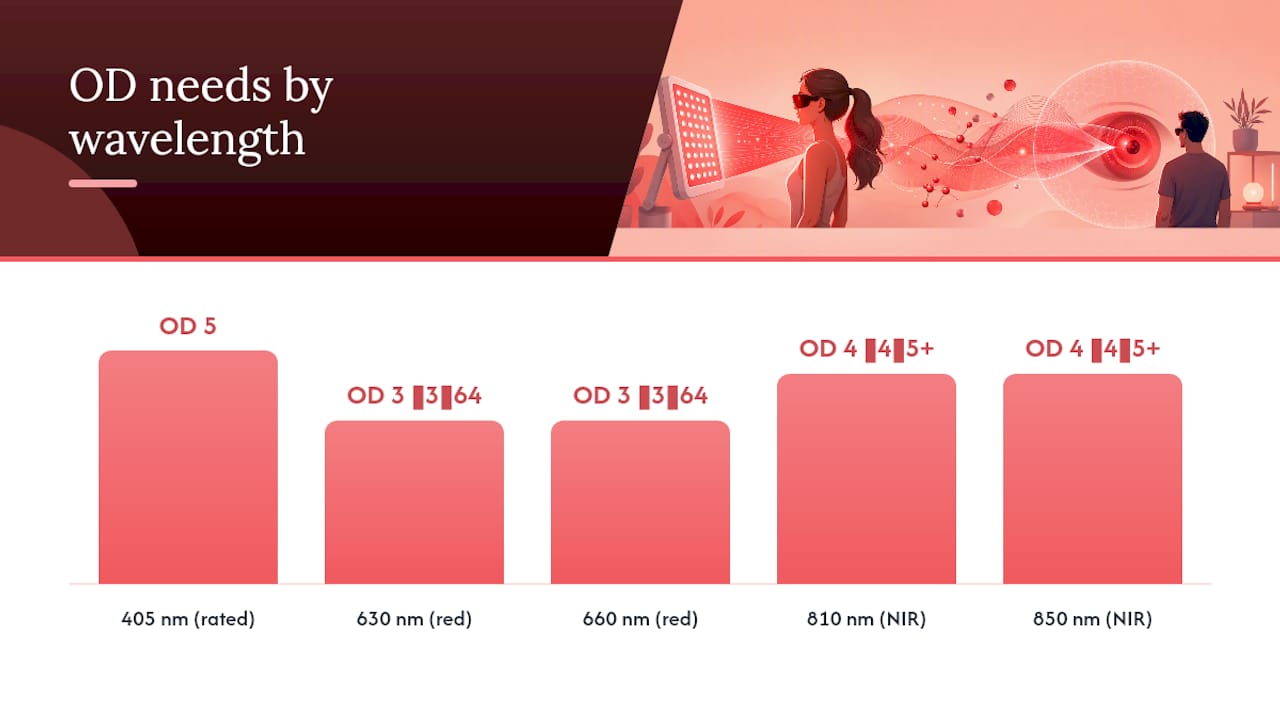
The number that actually tells you whether a shield works is Optical Density (OD), a logarithmic measure of how much light a lens blocks at a given wavelength. Higher OD means more blocking. For visible red light in the 630–680 nanometer range, consumer safety guidance points to OD 3–4 as a reasonable range for home use. For near-infrared in the 800–900 nanometer range, that guidance climbs to OD 4–5 or higher, reflecting NIR’s better tissue penetration and the fact that you can’t see it to judge intensity yourself.
One detail trips up a lot of buyers: OD ratings are wavelength-specific, not universal. A shield rated OD 5 at 405 nanometers tells you nothing about its performance at 850 nanometers. Reputable manufacturers publish spectral transmission charts showing OD across a range of wavelengths, not just a single averaged number. Before buying, confirm the chart covers your device’s exact output, whether that’s 630, 660, 810, or 850 nanometers.
Pro Tip: Never substitute regular sunglasses for rated safety goggles. Sunglasses are built to cut visible brightness and glare, not to hit a specific Optical Density at red or NIR wavelengths, so they can leave you with a false sense of security.
A few fit and maintenance basics round out the checklist. Look for wrap-around styles with foam seals that block light from sneaking in around the edges, since side-leakage defeats the purpose of even a high-OD lens. Inspect goggles periodically for scratches, cracked coatings, or gaps in the seal, and replace them once you spot damage. Clean lenses with a soft cloth rather than anything abrasive that could thin the coating over time.
Safety Steps for Every Device Type
The right protocol changes depending on what you’re using, so match your habits to your specific device rather than applying a blanket rule across everything you own.
- LED face masks: Keep your eyes closed for the full session unless the manufacturer explicitly states the mask is cleared for open-eye use. If the mask lacks eye-zone shielding and includes NIR wavelengths, add opaque inserts or goggles underneath rather than relying on the mask’s design alone. Most consumer masks run under 30 mW/cm² with built-in shielding, but unbranded or unlabeled masks are the riskier unknown.
- Handheld devices: Close the eye on whichever side you’re treating, and avoid pointing the emitter directly at the orbital area. For any periorbital work, such as treating fine lines near the eyes, goggles are the safer default rather than an occasional extra.
- Small consumer panels: Follow the manufacturer’s recommended distance, typically measured in feet rather than inches. At that distance, most panels fall into the lower irradiance bands and closed eyes are usually sufficient. If you stack two panels for a stronger dose, treat the combined output as higher-power and reconsider goggles.
- Full-body panels: Distance is your biggest ally here, since most full-body sessions happen several feet from the panel where irradiance at eye level drops substantially. Longer sessions or multiple panels aimed at one area change that math, so goggles become more worthwhile the closer and longer the exposure gets.
- Special situations: Children, anyone with a recent eye surgery, and people on photosensitizing medication should talk to an eye-care professional before starting red light therapy at all, not just before skipping goggles. Cleveland Clinic advises that eye-directed protocols specifically should only happen under professional supervision.
For anyone shopping for a mask or panel and weighing how shielding factors into the decision, it helps to understand what’s actually inside these devices. Our breakdown of RF, EMS, and LED light therapy facial devices covers how eye-zone design differs across common at-home formats.
Warning Signs and What to Do After Exposure
Most reactions to red light exposure are mild and pass quickly. After-images, a touch of glare, watery eyes, or a mild headache after a session are common and usually resolve within an hour or two once you’re back in normal lighting.
Some symptoms are not routine and deserve prompt attention:
- Vision changes that persist beyond a session, rather than fading within minutes
- Flashes of light or new floaters that appear after treatment
- Severe or worsening eye pain
- Blurred vision that doesn’t clear up on its own
If you notice any of the above, stop the session immediately. Rest your eyes in dim, comfortable lighting, skip screens for a while, and resist the urge to self-treat with eye drops or anything else beyond rest. Monitor how you feel over the next few hours.
Persistent symptoms warrant a call to an ophthalmologist rather than a wait-and-see approach. Cleveland Clinic recommends professional evaluation whenever visual symptoms don’t resolve on their own. When you do seek care, bring specifics: the device model, its listed wavelength and power output, how close you were during the session, and how long the session lasted. That detail helps a specialist rule out anything unrelated far faster than a vague description of “some redness therapy device.”
A Practical Checklist for Choosing a Safer Device
Picking a device with eye safety built in from the start beats retrofitting protection after the fact. Before buying, run through this checklist:
- Irradiance at your actual distance: Ask for or look up specs measured at the distance you’ll actually use, not just at the panel’s face.
- Spectral output chart: Confirm whether NIR wavelengths (typically 800–900 nanometers) are present alongside visible red, since that changes your protection needs.
- Eye-zone design: Check whether the device includes built-in shielding around the eyes or requires separate goggles.
- Testing and safety documentation: Prefer devices with documented safety testing rather than vague marketing claims about being “clinically safe.”
Manufacturer transparency, meaning irradiance charts at multiple distances and a full spectral breakdown including any NIR component, is genuinely the most useful single piece of information you can use to decide whether goggles belong in your routine.
Sonedaskincare’s LED mask resources walk through exactly this kind of spec transparency, and our page on whether LED light therapy is safe covers the evidence behind at-home LED use in more depth. If you’re building a routine around a mask, our guide to how often to use an LED mask also touches on session length and how that factors into overall exposure. For anything specific to a device you already own or are considering, reaching out to customer support directly is the fastest way to get wavelength and irradiance answers rather than guessing from a product photo.
Our Take: Stop Guessing, Start Checking Your Specs
The biggest gap in most red light safety advice isn’t the science, it’s that people treat “do I need goggles” as a yes-or-no question about red light therapy in general, rather than a question about their specific device at their specific distance. That’s backwards. A $30 unbranded mask with no spectral chart and hidden NIR output deserves more caution than a well-documented professional panel used three feet away, even though the professional panel sounds scarier on paper.
The conventional advice oversimplifies in the other direction too, treating goggles as either always necessary or never necessary for “red light therapy” as a category. Power, distance, and NIR content are the only three variables that matter here.
If you take one thing from this guide, make it this: find your device’s irradiance chart before your next session, not after a headache sends you looking for answers. That single habit resolves more uncertainty than any general rule about masks versus panels ever could.
— Customer
This article is general information, not a substitute for advice from a qualified doctor. Consult a qualified healthcare professional about your own circumstances before acting on anything here.
Sources
A few references do most of the heavy lifting behind the guidance in this article, and they’re worth checking directly if you want the primary source rather than a summary of it.
- ICNIRP | LED
- Are LED lights safe for human health? | European Commission (SCHEER / Easy-read summaries)
- Do You Need Eye Protection for Red Light Therapy? Complete Safety Guide | SeekRedLight
Each source covers a different piece of the puzzle: ICNIRP and IEC set the technical thresholds, Cleveland Clinic offers clinical framing, and the SCHEER summary explains the biology behind why those thresholds exist in the first place.