Tech Neck Lines Treatment: What Actually Works

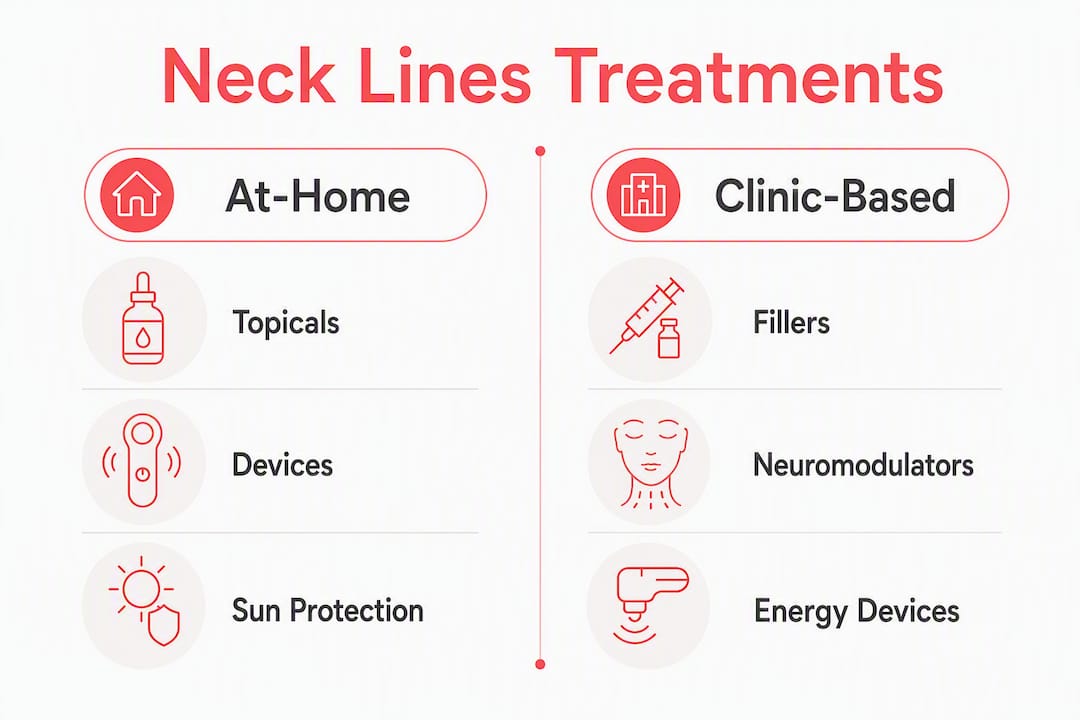
For most adults, the fastest visible improvement for tech neck lines combines clinic-based nonsurgical procedures with consistent at-home care. Hyaluronic acid fillers, energy-based devices like in-office HIFU, and microneedling deliver the most measurable early results. At-home retinoids, daily SPF, and a quality device keep those gains from fading.
Here are three steps you can start today:
- Raise your screen to eye level. Postural changes reduce mechanical skin folding and lower recurrence risk more than any topical alone.
- Apply a retinoid or peptide serum to your neck every night. Consistency over weeks to months is what drives visible change.
- Add daily SPF 30+ to your neck and décolletage. UV exposure accelerates collagen breakdown and deepens existing lines.
For clinic options, approximate U.S. cost benchmarks are provided for Botox sessions, neck filler sessions, and energy-based treatments, though exact amounts vary by provider and location. The American Society of Plastic Surgeons recognizes tech neck as a distinct cosmetic concern with both surgical and nonsurgical solutions, depending on severity.
Table of Contents
- What causes horizontal neck lines and why device use speeds them up
- At-home and topical treatments that reduce neck line appearance
- What clinic-based nonsurgical procedures can do for neck lines
- When surgery is the right answer for neck lines
- How to choose the right treatment and set realistic expectations
- At-home HIFU and sonophoresis devices: what the evidence shows
- Risks, side effects, and what recovery looks like
- Key Takeaways
- The gap between what clinic treatments promise and what actually matters at home
- The Sonedaskincare VividLift™: clinic-grade technology for at-home maintenance
- Useful sources and further reading
What causes horizontal neck lines and why device use speeds them up
Horizontal neck lines are skin furrows or creases that run across the neck. They are not the same as general skin laxity, though both can appear together. Understanding the difference matters because each responds to different treatments.

Two distinct mechanisms drive their formation. The first is mechanical folding: every time you look down at a phone or laptop, the skin at the front of your neck compresses and creases. Repeat that motion hundreds of times a day for years, and the skin “learns” the fold. The second is intrinsic aging: collagen and elastin production slows with age, subcutaneous fat redistributes, and the platysma muscle (the broad, flat muscle running down the front of the neck) develops fibrous bands that tether the overlying skin. Those tethered areas resist smoothing even when the skin above them is treated.
Younger adults, particularly those in their 20s and 30s, often develop superficial lines earlier than previous generations because of device posture. The lines start as dynamic creases (visible only when the neck is flexed) and progress to static lines (visible at rest) as collagen loss compounds the mechanical damage. Once static, topicals alone rarely erase them.
Pro Tip: Set your laptop or monitor so the top of the screen sits at or just below eye level. A simple laptop stand costs under $30 and is one of the most cost-effective preventive measures available.
At-home and topical treatments that reduce neck line appearance
Topicals and home devices will not replicate clinic results for deep static lines, but they are the foundation of any long-term plan. Used consistently, they slow progression, improve skin quality, and extend the results of any clinic procedure you choose.
Topical actives with real evidence
Retinoids are the most studied topical for neck lines. Research confirms retinoids stimulate collagen production and reduce wrinkle depth, but the neck is more sensitive than the face. Start with a low-concentration retinol at a gentle frequency two to three nights per week, then build frequency gradually over several weeks. Apply to dry skin and follow with a rich moisturizer to reduce irritation.
Peptides (such as Matrixyl or Argireline) support collagen synthesis and are gentler than retinoids, making them a good daily-use option or a substitute for those who cannot tolerate retinoids. Hyaluronic acid moisturizers plump the skin surface and improve the appearance of fine lines within hours, though the effect is temporary without underlying collagen support. Antioxidants (vitamin C, niacinamide) protect against UV-driven collagen degradation and improve tone.
Daily SPF 30 or higher is non-optional. Dermatologists consistently recommend extending your full facial skincare routine, including SPF and antioxidants, down to the neck and décolletage rather than relying on specialized neck creams alone.
At-home devices: what the evidence shows
Home-use LED, microcurrent, and RF devices can produce measurable neck firming and smoothing. Consumer panel testing found visible firming and smoothing after regular multi-week use, with consistency identified as the deciding factor. A device used twice a week for two months will outperform one used sporadically for six months. For a broader look at how these technologies compare, Sonedaskincare’s guide to RF, EMS, and LED facial devices breaks down the mechanisms clearly.
A practical at-home routine
- Cleanse and pat dry.
- Apply serum (peptide or antioxidant vitamin C in the morning; retinoid at night on dry skin).
- Moisturize with a hyaluronic acid or ceramide-rich formula.
- SPF 30+ every morning, reapplied if outdoors.
- Device session (LED, microcurrent, or RF) two to four times per week, per manufacturer protocol.
Realistic timelines: surface hydration improves within days. Tone and texture changes from retinoids take six to twelve weeks. Meaningful collagen remodeling from devices requires three to six months of consistent use.
Safety note: Stop use and consult a dermatologist if you experience persistent redness, peeling, or irritation. Never use high-intensity devices over the front of the neck (thyroid area).
What clinic-based nonsurgical procedures can do for neck lines
Clinic procedures address what topicals cannot: deep static furrows, tethered fibrous bands, volume loss, and significant skin laxity. The right procedure depends on which of those factors is driving your lines.

Procedure overview
Hyaluronic acid (HA) fillers are the most evidence-backed injectable option for horizontal neck lines. A systematic review of 12 studies found HA fillers have the most robust and consistent evidence for treating horizontal neck rhytides, with neuromodulators showing more modest, shorter-lived results. A prospective study using HA filler with a blunt cannula showed peak improvement at one to three months and sustained effects up to six months after a single session in 30 subjects treated with approximately 3 ml of filler.
Subcision + filler is the preferred sequence when fibrous bands tether the skin. Subcision releases those fibromuscular bands before filler is injected, allowing the filler to smooth the furrow more naturally. Filler alone in tethered tissue often produces a lumpy or incomplete result.
Neuromodulators (Botox) relax the platysma muscle, softening dynamic lines and reducing downward pull on the lower face. The same systematic review found neuromodulators perform best when combined with HA fillers rather than used alone.
Microneedling (with or without PRP or RF) creates controlled micro-injuries that trigger collagen remodeling. It works well for surface texture and mild laxity but requires a series of three to six sessions spaced four to six weeks apart.
Lasers (ablative: CO2, Er:YAG; nonablative: Fraxel) resurface the skin and stimulate collagen. Ablative lasers deliver more dramatic results but require five to fourteen days of downtime. Nonablative options need more sessions with less recovery.
RF (radiofrequency) devices heat the dermis to stimulate collagen contraction and new production. In-office RF is more powerful than home devices and typically requires two to four sessions.
In-office HIFU (High-Intensity Focused Ultrasound) delivers ultrasound energy to the deep dermis and SMAS layer, producing lifting and tightening over three to six months. One to two sessions per year is a common maintenance schedule.
Treatment comparison
| Procedure | Best for | Sessions needed | Downtime | Approx. U.S. cost |
|---|---|---|---|---|
| HA filler (blunt cannula) | Static furrows, volume loss | 1–2 | Minimal (1–3 days bruising) | ~$1,000/session |
| Subcision + filler | Tethered fibrous bands | 1–2 | Mild bruising, 3–5 days | $1,200+ |
| Neuromodulator (Botox) | Dynamic lines, platysmal bands | 1 (repeat every 3–4 months) | None | ~$500/session |
| Microneedling (RF or PRP) | Texture, mild laxity | 3–5 | 1–3 days redness | $300–$800 |
| Nonablative laser | Texture, tone, mild lines | 3–5 | 1–3 days | $500–$1,000/session |
| Ablative laser | Moderate to deep lines | 1–2 | 5–10 days | $1,500–$4,000 |
| In-office HIFU | Skin laxity, lifting | 1–2/year | Minimal | $1,500–$4,000 |
Cost figures are approximate U.S. patient averages and vary by provider, geography, and volume treated.
Clinician selection: Always choose a board-certified dermatologist or plastic surgeon for injectable and energy-based procedures. Ask specifically about blunt cannula technique for fillers. Blunt cannula approaches reduce bruising and complications compared with sharp-needle injections in the thin neck tissue. Request before-and-after photos of neck cases specifically, not just facial work.
When surgery is the right answer for neck lines
Nonsurgical options have real limits. If you have significant skin laxity (loose, hanging skin), prominent platysmal banding visible at rest, or excess submental fat that energy devices cannot address, a surgical neck lift is likely the most effective path.
Surgery corrects structural problems that no filler or device can fix:
- Platysmal banding: The surgeon tightens or partially removes the platysma muscle, eliminating the vertical or horizontal bands that create visible cords.
- Excess skin: Redundant skin is excised, not just tightened. Fillers and RF can tighten mildly lax skin, but they cannot remove it.
- Submental fat: Liposuction or direct excision removes fat deposits that create a heavy, undefined jawline.
The American Society of Plastic Surgeons outlines both surgical and nonsurgical approaches to tech neck, noting that the choice depends on the degree of laxity and the patient’s goals.
Typical surgical timeline:
- Preoperative planning and medical clearance: two to four weeks before surgery.
- Procedure: performed under local anesthesia with sedation or general anesthesia, typically two to four hours.
- Initial recovery: one to two weeks before returning to desk work; bruising and swelling resolve over three to four weeks.
- Final results: visible at three to six months as residual swelling clears and collagen remodels.
Risks to know: Hematoma, nerve injury, scarring, and anesthesia complications are the primary surgical risks. Infection is rare but possible. Consult only board-certified plastic surgeons and ask about their specific neck lift volume and complication rates.
How to choose the right treatment and set realistic expectations
The severity of your lines is the clearest guide to where to start. Here is a practical decision path:
- Mild, superficial lines (dynamic, visible mainly when neck is flexed): Start with posture correction, daily SPF, retinoids, and a consistent home device routine. Give it three to six months before escalating.
- Moderate static lines (visible at rest, no significant laxity): Add clinic-based HA filler or subcision + filler. Combine with a neuromodulator if platysmal activity is contributing. Expect peak results at one to three months post-treatment.
- Moderate laxity with lines: Consider in-office HIFU or RF combined with fillers. Combination approaches consistently outperform single-modality treatment.
- Significant laxity, banding, or excess fat: Request a surgical consultation with a board-certified plastic surgeon.
Questions to ask any provider before booking:
- What is your specific training and certification for neck injections or energy devices?
- How many neck cases do you perform per month?
- Do you use blunt cannula technique for fillers?
- What is your protocol if I develop a lump or vascular complication?
- What maintenance schedule do you recommend after the initial treatment?
Red flags: Providers who guarantee specific results, offer steep discounts on filler volume without a clinical rationale, or cannot show neck-specific before-and-after photos warrant caution. High-volume discount clinics with limited follow-up access are a consistent risk factor for complications.
At-home HIFU and sonophoresis devices: what the evidence shows
At-home energy devices occupy a real and growing role in neck care, provided you understand what they can and cannot do. They are not a substitute for clinic procedures in cases of significant laxity or deep static lines. For mild to moderate lines and as maintenance after clinic treatment, the evidence is genuinely encouraging.
What the studies show
An 84-day prospective study of a topical neck treatment applied twice daily showed significant improvement in horizontal neck lines, skin elasticity, hydration, and tone, corroborated by clinical photography and ultrasound. The key variable was consistent twice-daily use over the full study period. Consumer panel testing of home-use neck devices similarly found that regular multi-week use produced visible firming and smoothing, with consistency as the primary success driver.
Evidence context: study durations and reported outcomes
| Intervention | Study duration | Primary reported outcome |
|---|---|---|
| Topical neck treatment (twice daily) | 84 days | Improved lines, elasticity, hydration, tone |
| HA filler (blunt cannula, ~3 ml) | several-month follow-up | Peak improvement at 1–3 months; sustained for several months |
| Home-use neck devices (consumer panel) | Multi-week trial | Visible firming and smoothing with consistent use |
Safety rules for at-home devices
Never apply microcurrent, RF, or high-intensity ultrasound applicators directly over the front of the neck. The thyroid gland sits in that area, and device safety guidance consistently warns against front-neck use. Target the jawline, sides of the neck, and décolletage instead. If you have implants, a pacemaker, or any active medical condition affecting the neck, consult your clinician before starting any device protocol.
Integrating devices with your skincare routine
Apply your serum or a conductive gel before a device session to enhance contact and product absorption. Sonophoresis specifically uses low-frequency ultrasound to drive active ingredients deeper into the skin, making the combination of device use and a quality serum more effective than either alone. Follow with moisturizer and, in the morning, SPF.
A practical weekly schedule: device sessions two to four times per week, retinoid on off-nights, SPF every morning. Expect to see measurable hydration and texture improvement within four to six weeks; structural firming takes three to six months.
Pro Tip: Pair your device session with a peptide or hyaluronic acid serum rather than a retinoid. Retinoids can increase skin sensitivity to energy-based treatments, and the sonophoresis effect works best with hydrating, non-irritating formulas.
Sonedaskincare’s VividLift™ combines HIFU and sonophoresis in a single at-home device, designed to stimulate collagen production, support skin lifting, and enhance serum absorption. It is built for adults who want a clinically inspired maintenance tool between clinic visits or as a standalone option for mild to moderate concerns. For a deeper look at how at-home light therapy devices perform, Sonedaskincare’s evidence summary covers the key studies and practical use cases.
Risks, side effects, and what recovery looks like
Every treatment carries a risk profile. Knowing what is normal versus what needs immediate attention protects you.
Topicals and home devices:
- Common: mild redness, dryness, or peeling with retinoids (usually resolves with reduced frequency and added moisturizer).
- Rare: contact dermatitis or allergic reaction. Patch test new products on the inner arm first.
- Device-specific: avoid front-neck use; stop if you feel sharp pain or unusual heat.
Fillers and subcision:
- Common: bruising, swelling, and mild tenderness for one to five days.
- Serious but rare: vascular occlusion (filler entering a blood vessel) can cause tissue damage or, in extreme cases, vision changes. Seek immediate care for severe pain, blanching, or any visual disturbance after injection.
- Lumps: small nodules can occur. Hyaluronidase dissolves HA filler and is the standard treatment. Ask your provider about their protocol before your appointment.
Neuromodulators:
- Common: mild injection-site bruising, headache for 24–48 hours.
- Rare: asymmetry, difficulty swallowing if product migrates. Choose an experienced injector for neck treatments specifically.
Lasers:
- Common: redness, swelling, and crusting for three to fourteen days depending on ablative vs. nonablative.
- Serious: hyperpigmentation (more common in darker skin tones), scarring, or infection if aftercare is not followed.
RF and in-office HIFU:
- Common: temporary redness, mild swelling, tingling.
- Rare: burns or blistering if device settings are incorrect. This is why provider credentials matter.
Surgery:
- Common: bruising, swelling, and tightness for two to four weeks.
- Serious: hematoma (most common surgical complication), nerve injury, infection, or anesthesia reaction.
Red-flag symptoms requiring immediate medical attention: severe or worsening pain after any injectable procedure, vision changes, rapidly expanding swelling, skin that turns white or mottled after filler, or signs of infection (increasing redness, warmth, fever) after any procedure.
Aftercare basics: ice the area for the first 24 hours after injectables, avoid strenuous exercise for 24–48 hours, sleep with your head elevated, and follow your provider’s specific topical care instructions.
Key Takeaways
Combining posture correction, daily SPF, consistent topicals, and clinic-based procedures gives adults with tech neck lines the most durable results across all severity levels.
| Point | Details |
|---|---|
| Start at home today | Raise your screen, apply retinoid or peptide serum nightly, and use SPF 30+ every morning. |
| HA fillers lead clinic options | A systematic review of 12 studies found HA fillers have the most robust evidence for horizontal neck lines, with effects sustained for several months. |
| Consistency drives device results | Home devices produce visible firming only with regular multi-week use; sporadic sessions yield little measurable change. |
| Match treatment to severity | Mild lines: homecare and devices. Static lines: filler or subcision + filler. Significant laxity: energy-based or surgical consult. |
| Sonedaskincare VividLift™ | Combines HIFU and sonophoresis for at-home collagen stimulation and serum absorption, suited for maintenance and mild to moderate concerns. |
The gap between what clinic treatments promise and what actually matters at home
Most guides on tech neck lines treatment focus almost entirely on clinic procedures. That framing is understandable. Fillers and HIFU produce faster, more visible results than any topical. But it misses something important: the people who see the best long-term outcomes are not the ones who book the most sessions. They are the ones who change their posture and maintain a daily skincare routine between appointments.
The 84-day topical study is instructive here. Twice-daily application for nearly three months produced clinically measurable improvements in elasticity and hydration. That is not a dramatic transformation, but it is real, documented change from a consistent routine. The same principle applies to home devices. The evidence for at-home LED, microcurrent, and RF is not as strong as for in-office procedures, but it is not negligible either, and it compounds over time in a way that a single clinic visit cannot.
The other thing most guides understate is the role of fibrous bands. Many adults with moderate neck lines have tethered tissue that filler alone will not smooth. Subcision first, then filler, is the sequence that actually works in those cases. Asking your provider specifically about this before booking a filler appointment is one of the most useful questions you can ask.
At-home HIFU and sonophoresis devices sit in a practical middle ground: not a replacement for clinic procedures in cases of real laxity, but a clinically inspired maintenance tool that keeps skin quality high between visits. Used with the right serum and a consistent schedule, they extend the value of whatever clinic investment you make.
Individual results vary. For any procedural treatment, consult a board-certified dermatologist or plastic surgeon. This article is general information, not medical advice.
The Sonedaskincare VividLift™: clinic-grade technology for at-home maintenance
Clinic visits address the deep structural work. Between appointments, or as a standalone option for mild to moderate lines, you need something that actually maintains skin quality rather than just moisturizing the surface.

The Sonedaskincare VividLift™ 2-in-1 HIFU + sonophoresis device delivers two clinically inspired technologies in one at-home tool. HIFU targets the deep dermis to stimulate collagen production and support skin lifting. Sonophoresis uses low-frequency ultrasound to drive active serums deeper into the skin than topical application alone can achieve, with clinical results showing a 175% increase in skin hydration. It is built for adults who want professional-grade maintenance without the clinic price tag or scheduling friction.
VividLift™ is best suited for adults with mild to moderate neck lines who want to support and extend clinic results, or who prefer a consistent at-home protocol. It is not a substitute for surgical correction or in-office procedures in cases of significant laxity. Always consult your clinician before use if you have medical conditions affecting the neck or thyroid area.
Preorder VividLift™ and start a clinically inspired at-home routine backed by Sonedaskincare’s 100% Money-back Guarantee.
Useful sources and further reading
The studies and resources below form the evidence base for this guide. Each is worth reading directly if you want to verify a specific claim or go deeper on a treatment option.
“The available treatment options for horizontal neck lines are limited, and combination approaches that address both the skin surface and underlying fibrous structures tend to produce the most natural-looking outcomes.” — from clinical literature on neck line correction
-
A Rejuvenating treatment targeting “tech neck” lines and wrinkles: prospective study — An 84-day prospective study showing twice-daily topical treatment improved horizontal neck lines, elasticity, hydration, and tone. Useful for setting realistic timelines for topical routines.
-
A Systematic Review of Injectable Treatment Options for Horizontal Neck Rhytides — Reviews 12 studies comparing HA fillers and neuromodulators. The strongest available evidence base for injectable treatment decisions.
-
Efficacy and safety of HA filler for horizontal neck lines — Prospective study of 30 subjects showing peak filler results at one to three months, sustained to six months. Directly relevant to cost and timeline planning.
-
Treatment of horizontal neck lines (MDedge) — Clinical commentary on subcision + filler sequencing for tethered fibrous bands. Read this before any filler consultation.
-
Fix tech neck: Surgical and nonsurgical options (ASPS) — American Society of Plastic Surgeons overview of tech neck as a recognized cosmetic concern, covering both surgical and nonsurgical approaches.
-
Injection technique: cannula vs. needle — Clinical literature comparing blunt cannula and sharp-needle injection techniques. Relevant when evaluating provider technique for neck fillers.
-
Horizontal necklines correction with polydioxanone threads — Case series exploring braided PDO threads as a scaffold-based treatment option for neck lines. Useful background on emerging alternatives.
-
Do retinoids really reduce wrinkles? (Harvard Health) — Clear, evidence-based explainer on retinoid mechanisms and realistic expectations. A reliable reference for topical treatment decisions.
-
How to prevent and fix tech neck (NewYork-Presbyterian) — Clinical health-education guidance on posture and ergonomic changes that reduce mechanical neck folding. Start here for prevention.
-
Sonedaskincare VividLift™ HIFU + sonophoresis device — Product page for the VividLift™ device, including technology specifications, clinical hydration data, and usage protocols.
This article summarizes published evidence and general guidance. It is not a substitute for individualized medical advice. Consult a board-certified dermatologist or plastic surgeon before pursuing any procedural treatment.